
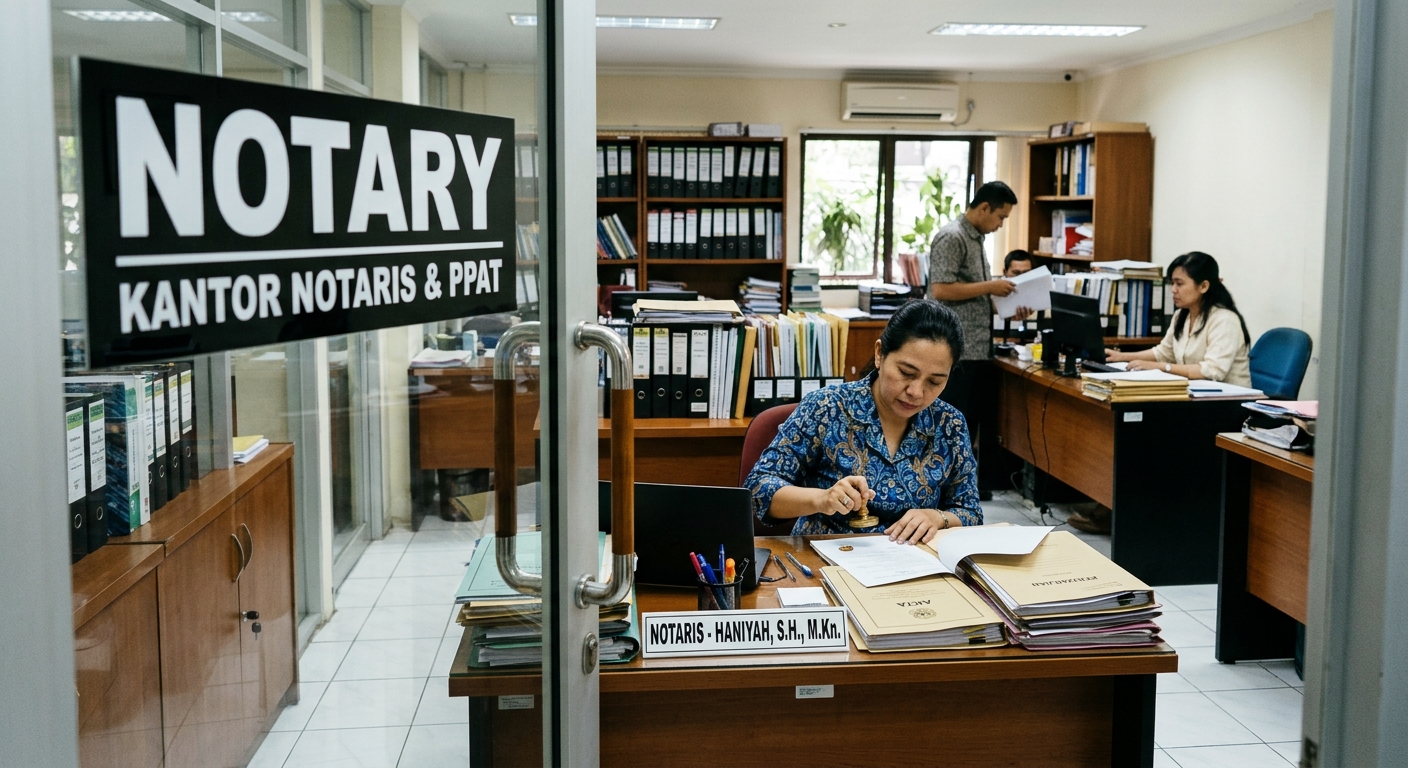
Why Indonesian Notary Services Are the First Due Diligence Check for Foreign Investors

Indonesian Notary Services


Most foreign investors think Indonesian Notary Services is only about filing documents at the very end of the legal process.

In reality, some of the most expensive mistakes made by PT PMAs happen right at the notary’s desk.

The trouble is that many investors also assume that once a deed has been signed and notarized, everything must be legally sound.

Not necessarily.

A notary can authenticate a document. That doesn’t mean the business structure behind it is compliant, suitable for your licence, or even capable of supporting the visa, property, or investment strategy you had in mind.

And when something is wrong, the problem often doesn’t appear immediately. It surfaces months later during a licence application, a KITAS renewal, a tax review, or a due diligence process before a sale.

By then, fixing it is usually more expensive than getting it right in the first place.


So What Does a Notary Services Actually Do?

In Indonesia, a notary is a public official authorised to prepare and authenticate certain legal documents.

For foreign investors, that generally means dealing with:

▪️ PT PMA and company establishment deeds
▪️ Shareholder resolutions and amendments
▪️ Property and registered-lease agreements
▪️ Powers of attorney
▪️ Corporate restructuring documents

The notary’s role is important because these documents become the legal record of how the company is structured. But here’s the part many investors misunderstand.


What a Notary Does NOT Do

A notary does not approve your business model.
A notary does not decide whether your villa is in the correct zoning area.
A notary does not confirm that your tax structure works.
A notary does not guarantee your licence application will be successful.
And a notary certainly cannot promise that Immigration will issue your KITAS.

Yet we often hear a familiar sentence: “The notary already approved it.”

That statement can create a false sense of comfort.

An authenticated document and a regulator-approved business structure are not the same thing.

A deed can be perfectly notarized and still contain a structure that will raise questions later.


Where Investors Usually Get Into Trouble

One of the most common examples involves share capital.

Many foreign investors have heard about the IDR 2.5 billion paid-up capital requirement for a PT PMA following Ministry of Investment/BKPM Regulation No. 5 of 2025.

But confusion starts when people mix up:

authorised capital
issued capital
paid-up capital

These are not interchangeable.

Imagine a deed shows IDR 10 billion worth of issued shares, but only IDR 2.5 billion was ever deposited into the company account.

The company can still be formed. The deed can still be signed.

But sooner or later, that mismatch is likely to trigger questions during an audit, licence review, corporate restructuring, or investor due diligence exercise.

A good notary will spot these issues before the deed is completed, not after the documents have already been filed.


The Cheapest Due Diligence You’ll Ever Pay For

Ironically, investors often spend more time reviewing villa finishes than reviewing the legal structure of the company buying the villa.

That’s backward.

The right notary won’t just prepare documents.

They’ll ask questions.

They’ll identify inconsistencies.

They’ll tell you when the paperwork doesn’t match reality.

And sometimes, they may save you from a mistake that could cost far more than their professional fee.


Before Signing Anything

Before engaging a notary, ask yourself:

✓  Have they handled PT PMA structures before?

✓  Do they clearly explain what they are responsible for — and what they are not?

✓  Does the capital stated in the deed reflect real capital that’s actually been deposited?

✓  Have all shareholder details been checked and verified?

✓  Are they coordinating with your legal, tax, and immigration advisers?

If the answer to any of those questions is unclear, stop and ask more questions.

Because once a deed is signed, fixing the structure is usually harder than building it correctly from the start.

Indonesian Notary Services are not a rubber stamp. They are where an investment structure becomes legally documented and where avoidable defects can be caught early. For foreign investors, treating the notary as a due diligence partner rather than a formality is one of the cheapest risk controls available.


This article is general information, not legal or tax advice for a specific transaction. For notary assistance, contact Seven Stones Indonesia’s legal team via WhatsApp, or read our guide to notary services for your business.

Latest Article
Why Indonesian Notary Services Are the First Due Diligence Check for Foreign Investors
  Most foreign investors think Indonesian Notary Services is only about filing documents at the...
Foreign Investors Show Growing Interest in Indonesia's Other Services Sector
Foreign investment in Indonesia jumped 86.02% between January and September 2026, according to research...
Property Investment Tops Rp120.4 Trillion Through September 2026, Bali Attracts Largest FDI Share
  Indonesia’s property sector attracted approximately Rp120.4 trillion in investment between...
Indonesia’s Ministry of Law to Sanction Companies That Fail to Submit Annual Reports
  Indonesia’s Directorate General of General Legal Administration (AHU) under the Ministry...
Indonesia’s Property Market Recovery Puts the Spotlight on Asset Quality
  Indonesia’s property market continued to show signs of a more structured recovery in the third...

Andrzej Barski

Director of Seven Stones Indonesia

Andrzej is Co-owner/ Founder and Director of Seven Stones Indonesia. He was born in the UK to Polish parents and has been living in Indonesia for more than 33-years. He is a skilled writer, trainer and marketer with a deep understanding of Indonesia and its many cultures after spending many years travelling across the archipelago from North Sumatra to Irian Jaya.

His experience covers Marketing, Branding, Advertising, Publishing, Real Estate and Training for 5-Star Hotels and Resorts in Bali and Jakarta, which has given him a passion for the customer experience. He’s a published author and a regular contributor to local and regional publications. His interests include conservation, eco-conscious initiatives, spirituality and motorcycles. Andrzej speaks English and Indonesian.

Terje H. Nilsen

Director of Seven Stones Indonesia

Terje is from Norway and has been living in Indonesia for over 20-years. He first came to Indonesia as a child and after earning his degree in Business Administration from the University of Agder in Norway, he moved to Indonesia in 1993, where he has worked in leading positions in education and the fitness/ wellness industries all over Indonesia including Jakarta, Banjarmasin, Medan and Bali.

He was Co-owner and CEO of the Paradise Property Group for 10-years and led the company to great success. He is now Co-owner/ Founder and Director of Seven Stones Indonesia offering market entry services for foreign investors, legal advice, sourcing of investments and in particular real estate investments. He has a soft spot for eco-friendly and socially sustainable projects and investments, while his personal business strengths are in property law, tourism trends, macroeconomics, Indonesian government and regulations. His personal interests are in sport, adventure, history and spiritual experiences.

Terje’s leadership, drive and knowledge are recognised across many industries and his unrivalled network of high level contacts in government and business spans the globe. He believes you do good and do well but always in that order. Terje speaks English, Indonesian and Norwegian.

Contact Our Consultants

Ridwan Jasin Zachrie

CFO of Seven Stones Indonesia, Jakarta

Ridwan is one of Indonesia’s top executives with a long and illustrious career in the financial world. He holds several professional certifications including being a Certified Business Valuer (CBV) issued by the Australian Academy of Finance and Management; Broker-Dealer Representative (WPPE); and The Directorship Certification for Directors and Commissioners, issued by the Indonesian Institute of Commissioners and Directors.

His experience includes being the Managing Director at one of the top investment banking groups in the region, the Recapital Group, the CFO at State-owned enterprises in fishery industry and the CEO at Tanri Abeng & Son Holding. He’s also been an Independent Commissioner in several Financial Service companies and on the Audit and Risk Committee at Bank BTPN Tbk, Berau Coal Energy Tbk, Aetra Air Jakarta as well as working for Citibank, Bank Mandiri and HSBC. His last position was as CFO at PT Citra Putra Mandiri – OSO Group.

Ridwan has won a number of prestigious awards including the Best CFO Awards 2019 (Institute of Certified Management Accountant Australia-Indonesia); Asia Pacific Young Business Leader awarded by Asia 21 Network New York USA (Tokyo 2008); UK Alumni Business Awards 2008 awarded by the British Council; and The Most Inspiring Human Resources Practitioners’ version of Human Capital Magazine 2010.

He’s a member of the Board of Trustees of the Alumni Association of the Faculty of Law, Trisakti University, Co-Founder of the Paramadina Public Policy Institute and actively writes books, publications and articles in the mass media. He co-authored “Korupsi Mengorupsi Indonesia” in 2009, which helps those with an interest in understanding governance in Indonesia and the critical issue of corruption. Ridwan speaks Indonesian and English.

Per Fredrik Ecker

Managing Director of Seven Stones Indonesia, Jakarta

Per is the Managing Director of the Seven Stones Indonesia (SSI) Jakarta office and has more than 25-years’ experience in Indonesia, China, and Western Europe. He previously worked in senior management positions with Q-Free ASA, Siemens AG, and other companies in the telecom sector. Over the last six years, he has been the Chairman of the Indonesia-Norway Business Council (INBC) and recently become elected to be on the board of EuroCham Indonesia.

His most recent experience is within Intelligent Transport Solutions (ITS), Telecom, and other sectors within the Indonesian market. He is today through his position in SSI and by representing Norway Connect, promoting Nordic and European companies that would like to explore business opportunities in the Indonesian market. He’s also playing an active role to help create the Nordic House concept in Jakarta that will provide an excellent platform for Nordic companies entering Indonesia, where they’ll find a community that can offer support with trusted information and affordable services to enter this market.