
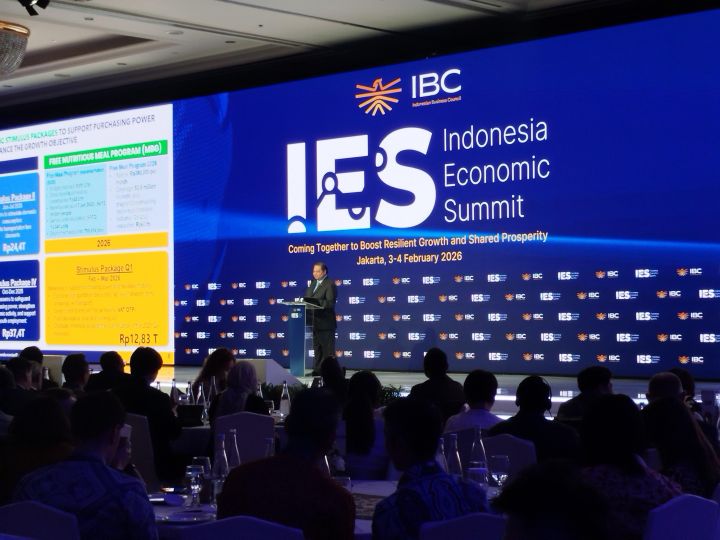
IES 2026 Aims to Strengthen Indonesia’s Economic Resilience

Airlangga Hartarto speaking at IES 2026

Amid growing global economic uncertainty, the summit is positioned as a strategic platform to reinforce Indonesia’s economic resilience and sustain long-term growth. The Indonesia Economic Summit (IES) 2026, organized by the Indonesian Business Council (IBC), is expected to play a critical role in encouraging investment while strengthening national competitiveness. As global economic conditions remain volatile due to slowing growth and geopolitical tensions, Indonesia seeks to maintain stability through policy clarity, collaboration, and concrete economic action. Scheduled to take place on February 3–4, 2026, the summit brings together key stakeholders to address these challenges and chart a forward-looking economic agenda.


IES 2026 as a Strategic Economic Forum

IES 2026 is designed as more than an annual economic gathering. Instead, it serves as a strategic forum that unites government officials, policymakers, business leaders, and international partners under one platform. Through this structure, the summit aims to strengthen Indonesia’s economic foundations while responding proactively to global uncertainty. The forum emphasizes cross-sector collaboration as a practical solution to complex economic challenges. By aligning public and private sector priorities, the forum seeks to reinforce confidence in Indonesia’s economic direction and institutional capacity.

Moreover, IBC positions the summit as a venue for shaping shared understanding and coordinated action. The discussions focus on building resilience within Indonesia’s economic structure rather than short-term responses. As a result, the summit supports long-term planning that aligns investment flows with national development goals.


IES 2026 Focuses on Investment and Policy Certainty

Investment remains a central pillar of IES 2026, particularly in the context of global economic instability. The summit highlights the need for predictable policies and a competitive investment climate to attract both domestic and foreign capital. Chairman of the IBC Supervisory Board, Arsjad Rasjid, stressed the urgency of this approach during the press conference.

“Amid global uncertainty, Indonesia must be able to provide policy certainty and a competitive investment climate,” he said.

This emphasis reflects Indonesia’s broader strategy to maintain investor confidence despite external pressures. By promoting clear regulations and consistent policy direction, the summit reinforces Indonesia’s position as a stable investment destination. Consequently, the summit aligns investment discussions with competitiveness and long-term economic resilience rather than short-term capital inflows.


Expanding Dialogue to Unlock Market Access

Unlike previous editions, IES 2026 introduces expanded bilateral and multilateral dialogue formats. These sessions aim to open new market access while creating tangible investment opportunities. Through structured discussions with international partners, the summit encourages deeper economic engagement and cooperation. This approach allows Indonesia to strengthen trade relationships and diversify investment sources.

Furthermore, the expanded dialogue format reflects a shift toward outcome-driven engagement. Rather than focusing solely on high-level discussions, the forum prioritizes actionable pathways that support market expansion. As a result, the summit enhances Indonesia’s ability to navigate global economic shifts while securing strategic economic partnerships.


Productivity, Industrialization, and Human Capital

Beyond investment, IES 2026 places strong emphasis on productivity, industrialization, and human capital development. These factors serve as key drivers of long-term economic competitiveness. The summit recognizes that sustainable growth depends on strengthening domestic industries and improving workforce capabilities.

By addressing productivity and industrial development together, the summit supports structural economic transformation. Human capital development, in particular, remains essential to sustaining competitiveness in an increasingly complex global economy. Therefore, the forum links workforce development with industrial growth to ensure that economic progress remains inclusive and resilient.


Turning Dialogue into Concrete Economic Action

The summit ultimately aims to translate dialogue into measurable outcomes. IBC emphasizes that the summit must deliver more than policy discussions. Arsjad Rasjid reinforced this expectation by stating, “What we need now is not just discourse, but real action to drive Indonesia’s economic growth.”

Through an action-oriented approach, IES 2026 seeks to generate concrete policy recommendations and strategic partnerships. These outcomes are expected to strengthen Indonesia’s economic resilience while positioning the country more competitively within the global economy. As global uncertainty persists, the summit stands as a platform for coordinated action, long-term planning, and sustainable economic progress.


Source: metrotvnews.com

Image: metrotvnews.com

Latest Article
IES 2026 Aims to Strengthen Indonesia’s Economic Resilience
Amid growing global economic uncertainty, the summit is positioned as a strategic platform to reinforce...
Indonesia Capital Market Reforms Gain Urgency After MSCI
Indonesia’s capital market reforms have gained urgency following heightened volatility in the stock...
Traditional Bali Arak Enters Regulated and Global Market
Bali Arak has entered a new phase of development as Indonesia’s Ministry of Industry formally granted...
Illegal Foreign Workers Cost Company Rp360 Million in Bintan
Illegal foreign workers have once again drawn regulatory attention in Indonesia, after authorities fined...
KBLI 2025 Changes Will Not Cancel Existing Business Licenses
Indonesia’s business community has closely watched the transition from KBLI (Indonesian Standard...

Andrzej Barski

Director of Seven Stones Indonesia

Andrzej is Co-owner/ Founder and Director of Seven Stones Indonesia. He was born in the UK to Polish parents and has been living in Indonesia for more than 33-years. He is a skilled writer, trainer and marketer with a deep understanding of Indonesia and its many cultures after spending many years travelling across the archipelago from North Sumatra to Irian Jaya.

His experience covers Marketing, Branding, Advertising, Publishing, Real Estate and Training for 5-Star Hotels and Resorts in Bali and Jakarta, which has given him a passion for the customer experience. He’s a published author and a regular contributor to local and regional publications. His interests include conservation, eco-conscious initiatives, spirituality and motorcycles. Andrzej speaks English and Indonesian.

Terje H. Nilsen

Director of Seven Stones Indonesia

Terje is from Norway and has been living in Indonesia for over 20-years. He first came to Indonesia as a child and after earning his degree in Business Administration from the University of Agder in Norway, he moved to Indonesia in 1993, where he has worked in leading positions in education and the fitness/ wellness industries all over Indonesia including Jakarta, Banjarmasin, Medan and Bali.

He was Co-owner and CEO of the Paradise Property Group for 10-years and led the company to great success. He is now Co-owner/ Founder and Director of Seven Stones Indonesia offering market entry services for foreign investors, legal advice, sourcing of investments and in particular real estate investments. He has a soft spot for eco-friendly and socially sustainable projects and investments, while his personal business strengths are in property law, tourism trends, macroeconomics, Indonesian government and regulations. His personal interests are in sport, adventure, history and spiritual experiences.

Terje’s leadership, drive and knowledge are recognised across many industries and his unrivalled network of high level contacts in government and business spans the globe. He believes you do good and do well but always in that order. Terje speaks English, Indonesian and Norwegian.

Contact Our Consultants

Ridwan Jasin Zachrie

CFO of Seven Stones Indonesia, Jakarta

Ridwan is one of Indonesia’s top executives with a long and illustrious career in the financial world. He holds several professional certifications including being a Certified Business Valuer (CBV) issued by the Australian Academy of Finance and Management; Broker-Dealer Representative (WPPE); and The Directorship Certification for Directors and Commissioners, issued by the Indonesian Institute of Commissioners and Directors.

His experience includes being the Managing Director at one of the top investment banking groups in the region, the Recapital Group, the CFO at State-owned enterprises in fishery industry and the CEO at Tanri Abeng & Son Holding. He’s also been an Independent Commissioner in several Financial Service companies and on the Audit and Risk Committee at Bank BTPN Tbk, Berau Coal Energy Tbk, Aetra Air Jakarta as well as working for Citibank, Bank Mandiri and HSBC. His last position was as CFO at PT Citra Putra Mandiri – OSO Group.

Ridwan has won a number of prestigious awards including the Best CFO Awards 2019 (Institute of Certified Management Accountant Australia-Indonesia); Asia Pacific Young Business Leader awarded by Asia 21 Network New York USA (Tokyo 2008); UK Alumni Business Awards 2008 awarded by the British Council; and The Most Inspiring Human Resources Practitioners’ version of Human Capital Magazine 2010.

He’s a member of the Board of Trustees of the Alumni Association of the Faculty of Law, Trisakti University, Co-Founder of the Paramadina Public Policy Institute and actively writes books, publications and articles in the mass media. He co-authored “Korupsi Mengorupsi Indonesia” in 2009, which helps those with an interest in understanding governance in Indonesia and the critical issue of corruption. Ridwan speaks Indonesian and English.

Per Fredrik Ecker

Managing Director of Seven Stones Indonesia, Jakarta

Per is the Managing Director of the Seven Stones Indonesia (SSI) Jakarta office and has more than 25-years’ experience in Indonesia, China, and Western Europe. He previously worked in senior management positions with Q-Free ASA, Siemens AG, and other companies in the telecom sector. Over the last six years, he has been the Chairman of the Indonesia-Norway Business Council (INBC) and recently become elected to be on the board of EuroCham Indonesia.

His most recent experience is within Intelligent Transport Solutions (ITS), Telecom, and other sectors within the Indonesian market. He is today through his position in SSI and by representing Norway Connect, promoting Nordic and European companies that would like to explore business opportunities in the Indonesian market. He’s also playing an active role to help create the Nordic House concept in Jakarta that will provide an excellent platform for Nordic companies entering Indonesia, where they’ll find a community that can offer support with trusted information and affordable services to enter this market.