
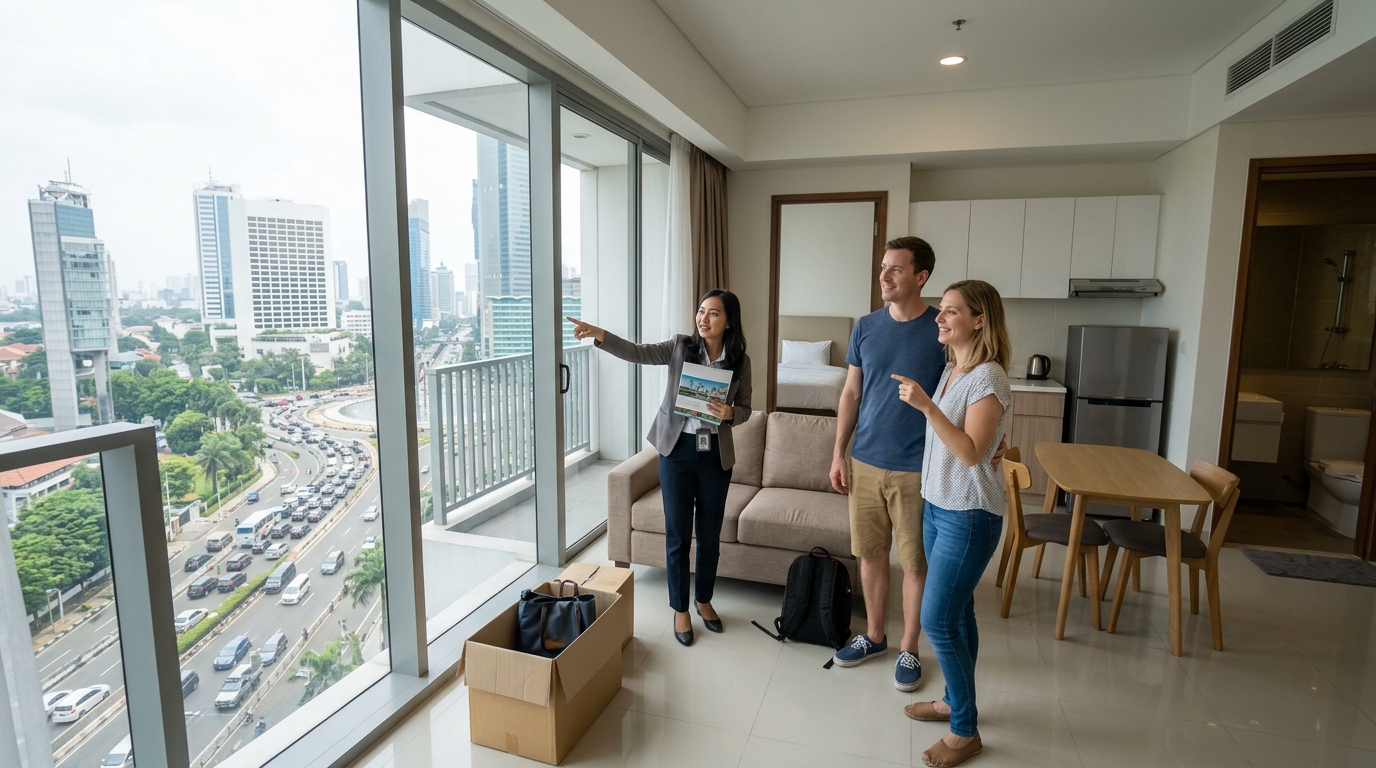
Jakarta’s expatriate housing market entered a new growth cycle in the first half of 2026, driven by rising investment across key sectors such as energy, mining, technology, and manufacturing.
As major projects move forward, demand for housing among foreign professionals is also gaining momentum.
According to Colliers Indonesia, the current market expansion differs from previous recovery periods, which were largely fueled by the return of economic activity following periods of disruption.
This time, demand is increasingly being driven by long-term investment commitments that are expected to bring a sustained inflow of expatriate talent into Indonesia.
At the same time, companies are becoming more selective when arranging accommodation for foreign employees.
Housing decisions are no longer based solely on availability. Employers are placing greater emphasis on cost efficiency, strategic location, unit size, and the overall value a property can offer.
Weaker Rupiah Reshapes Housing Choices
Exchange rate volatility has become one of the factors influencing Jakarta’s expatriate housing market.
In its Jakarta Expatriate Housing Market Report for H1 2026, Colliers noted a gap between the exchange rate assumptions used in corporate budgets and actual market conditions during the reporting period.
Many companies prepared their housing budgets based on an exchange rate of around Rp16,000-Rp16,800 per US dollar, while the market rate hovered between Rp17,900 and Rp18,000 per dollar.
As a result, corporate housing budgets have become more constrained, particularly when owners of premium properties continue to quote rents in US dollars.
According to Ferry Salanto, Head of Research at Colliers Indonesia, exchange-rate pressure does not automatically reduce corporate demand for expatriate housing. Instead, it has made companies more selective in their choices.
“Exchange-rate fluctuations affect the type of housing companies can realistically secure within their available budgets in Jakarta. Companies are not necessarily reducing their demand, but they are becoming more selective when evaluating location, unit size, and whether the benefits justify the cost,” said Ferry.
Despite tighter housing budgets, demand for expatriate accommodation remains relatively strong.
Companies are becoming more flexible in their housing strategies, opting for smaller units, expanding their search areas, or shifting from landed homes to apartments in an effort to balance costs with employee needs.
According to Lenny van Es-Sinaga, Head of Residential Services at Colliers Indonesia, expatriates are finding it increasingly difficult to secure suitable properties.
“Expatriates are finding it harder to secure their preferred homes. This is not only due to limited availability, but also because exchange-rate movements have pushed rental costs beyond the budgets allocated by companies,” said Lenny.
While landed homes remain the most sought-after option, both inside and outside residential compounds, owners of well-maintained and renovated properties have largely held firm on rental rates, leaving little room for negotiation.
As a result, the search and leasing process has become more selective and, in some cases, more time-consuming.
At the same time, serviced apartments are gaining traction as an alternative. Companies are also widening their property search to achieve a better balance between cost and amenities, reflecting a growing focus on value and budget efficiency in expatriate housing decisions.
Source: PropertynBank