
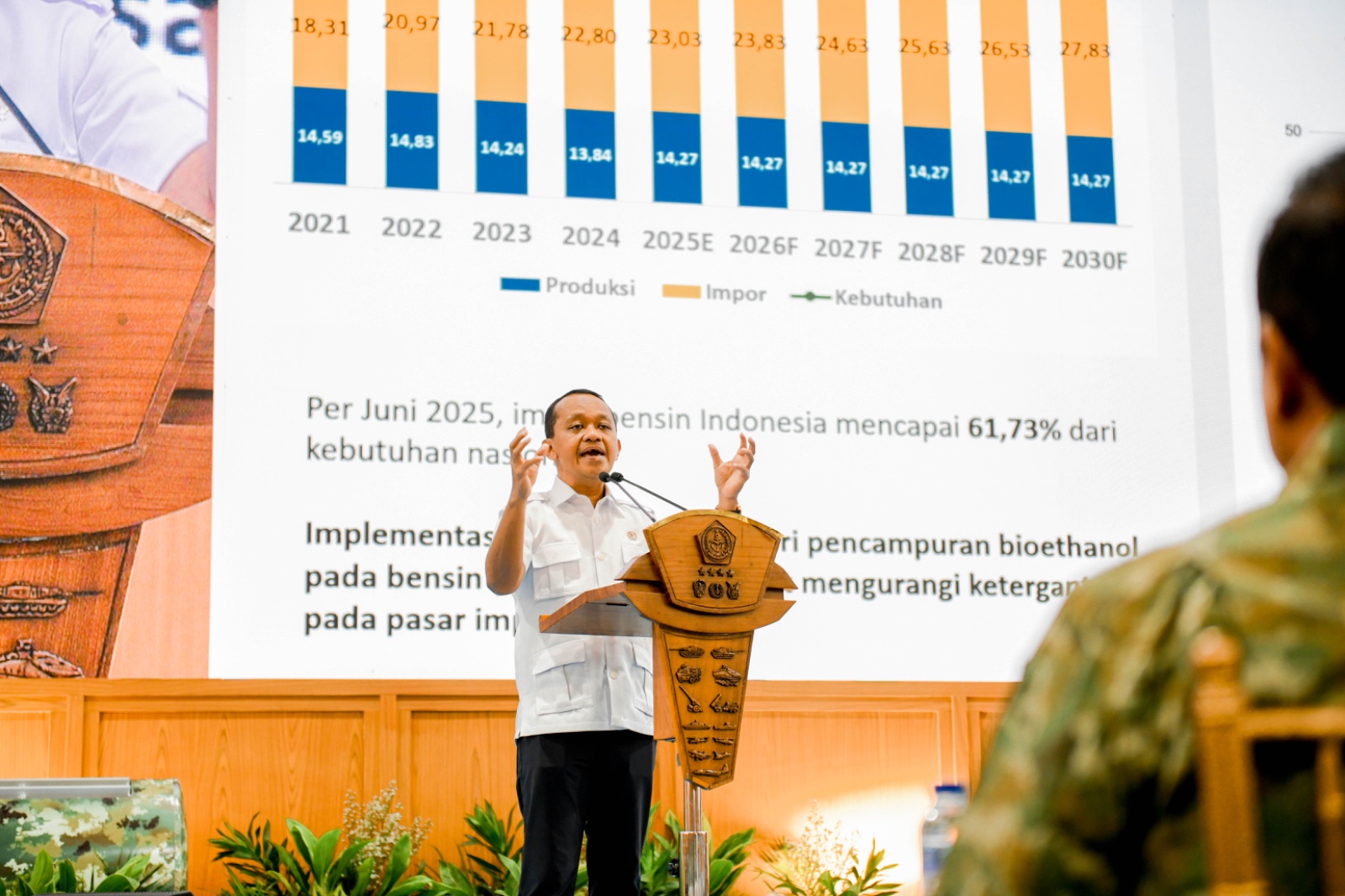
BOGOR – Indonesia has been recognized as the second best country in the world for energy security, according to a recent report by JP Morgan Asset Management.
The achievement was announced by Bahlil Lahadalia, Minister of Energy and Mineral Resources, during the 2026 Indonesian National Armed Forces Unit Commanders’ Rally in Bogor on 29 April 2026.
According to the JP Morgan report “Eye on the Market”— representing about 82% of global energy consumption— Indonesia took second place among 52 countries, following behind South Africa and surpassing China, which ranked third.
Domestic Production and New Discoveries Drive Resilience
Minister Bahlil credited the success to the government’s focus on maximizing domestic resources as a part of President Prabowo Subianto’s “Asta Cita” agenda, especially the energy self-sufficiency goal.
While global geopolitical tensions risk energy supplies worldwide, Indonesia’s sizable domestic production of oil, natural gas, and coal has acted as a shield against potential shortages.
Several key elements supporting Indonesia’s ranking include substantial domestic oil and gas output, sufficient coal production and reserves to meet national needs, and vast potential for new and renewable energy.
In 2025, Indonesia’s oil lifting reached the state budget target of 605,000 barrels per day, with a target of 610,000 bpd for 2026.
Out near East Kalimantan, under the sea, a find at Geliga-1 has added weight to Indonesia’s standing. This stretch of water belongs to the Ganal Block, where gas might reach 5 trillion cubic feet – alongside roughly 300 million barrels of condensate.
That liquid adds up to about 375 million barrels when counted like oil. Work points toward output beginning between 2028 and 2029. What lies below keeps gaining importance.
Bold Steps to End Fuel Imports
Indonesia is also making significant strides in reducing fuel imports. By the first of July, 2026, Indonesia plans to run its entire diesel supply on a blend called B50 (containing 50% palm oil). This change could stop the country from buying foreign diesel entirely.
According to Minister Bahlil, national diesel needs reach around 40 million kiloliters per year, and with the B40 to B50 program, Indonesia will no longer import diesel starting in 2026.
Moreover, work continues on alternatives to foreign LPG – including DME and CNG – already in use at eateries, lodging facilities, and refueling points that rely on local resources. With these steps come intentions of strengthening self-reliance in power supply. While progress unfolds slowly, the focus remains fixed on reducing outside dependence.
Source: esdm.go.id
Feat Image: esdm.go.id