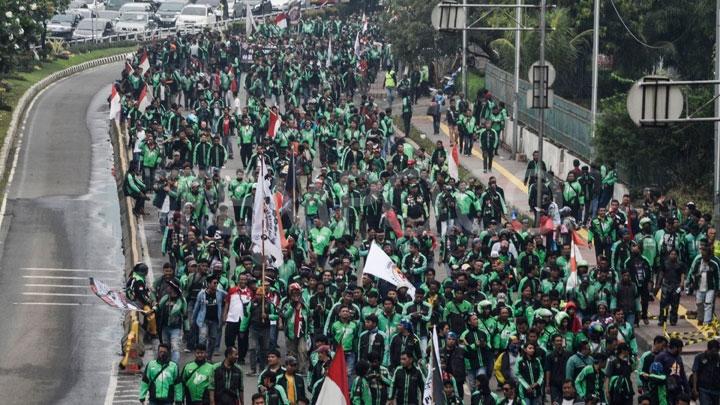
Rumors surrounding a potential Gojek Grab merger have triggered a wave of resistance from online drivers across Indonesia. The proposed consolidation of Southeast Asia’s two major ride-hailing companies has alarmed many in the industry, particularly those who fear the creation of a monopoly and the erosion of driver protections.
Drivers Push Back Against Gojek Grab Merger
Garda Indonesia, the national association for online motorbike taxi drivers, has voiced strong opposition to the rumored Gojek Grab merger. The organization believes the move could harm thousands of drivers and weaken healthy market competition.
“Garda will mobilize online drivers across Indonesia to reject this corporate move,” said Igun Wicaksono, Chairman of Garda Indonesia as reported by Tempo.co. He warned that the merger could lead to mass partnership terminations, worsen transparency, and leave drivers with fewer rights and less income stability.
The association sees the merger as a corporate efficiency strategy that risks sidelining driver welfare. Igun emphasized that the merger is not just a business decision; it has real consequences for those working on the ground.
Read More: Grab Falls Behind GoTo on Stock Markets
Transportation Monopoly Concerns Intensify
Beyond job security, Garda Indonesia raised serious transportation monopoly concerns. The association fears that combining Gojek and Grab would eliminate competition and form a dominant player in Indonesia’s online ride-hailing ecosystem.
Igun stated that the merger would effectively “form a monopoly in the online ojek business, which is not good.” He urged the government, especially the Business Competition Supervisory Commission (KPPU), to take a firm stance and review the merger plan carefully.
According to Garda, the merger could suppress local apps and digital platforms, making it harder for small startups and MSMEs to survive. “The government, through KPPU, must step in concretely because the impact will be highly detrimental to online drivers, the general public, and business players in this online application ecosystem,” Igun added.
Gojek’s Position on the Merger Rumors
In response to the public uproar, PT GoTo Gojek Tokopedia Tbk (GOTO) released a cautious statement. The company neither confirmed nor denied the merger discussions with Grab.
“There is no agreement between the Company and any party,” said Corporate Secretary R.A. Koesoemohadiani in an official disclosure to the Indonesia Stock Exchange on May 8, 2025.
She explained that GOTO is open to exploring various business opportunities but has not reached a decision yet. “The Company has not reached any decision regarding offers that may have been known or received by the Company,” she said.
Koesoemohadiani also stressed that management continues to evaluate proposals while considering long-term value creation. “With careful consideration of the best interests of driver partners, MSME partners, customers, employees, and all key stakeholders,” she added.
Business Competition Regulation Needed
As rumors persist, driver groups and industry observers are demanding tighter business competition regulation. Garda Indonesia argued that a Gojek Grab merger would give the new entity the power to set prices and commissions independently, without regard to government oversight.
Igun warned that such behavior reflects unhealthy corporate practices that bypass existing policies. He noted, “We as an association will continue to monitor this unhealthy corporate action. Online drivers will be the first and hardest hit by this move.”
The association insists that the government must play a stronger role in protecting worker rights and maintaining fair market dynamics.
Online Ride-Hailing Industry Faces Crossroads
The online ride-hailing industry in Indonesia stands at a crossroads. As Gojek and Grab explore potential business consolidation, the reaction from driver communities, regulators, and the public will shape the future of the sector.
While the merger may promise business efficiency and growth, it raises vital questions about market fairness, driver welfare, and digital ecosystem diversity. Government oversight will be crucial to ensuring that the outcome benefits all stakeholders, not just the corporate players involved.
Source: tempo.co, era.id
Image: TEMPO/Fakhri Hermansyah