
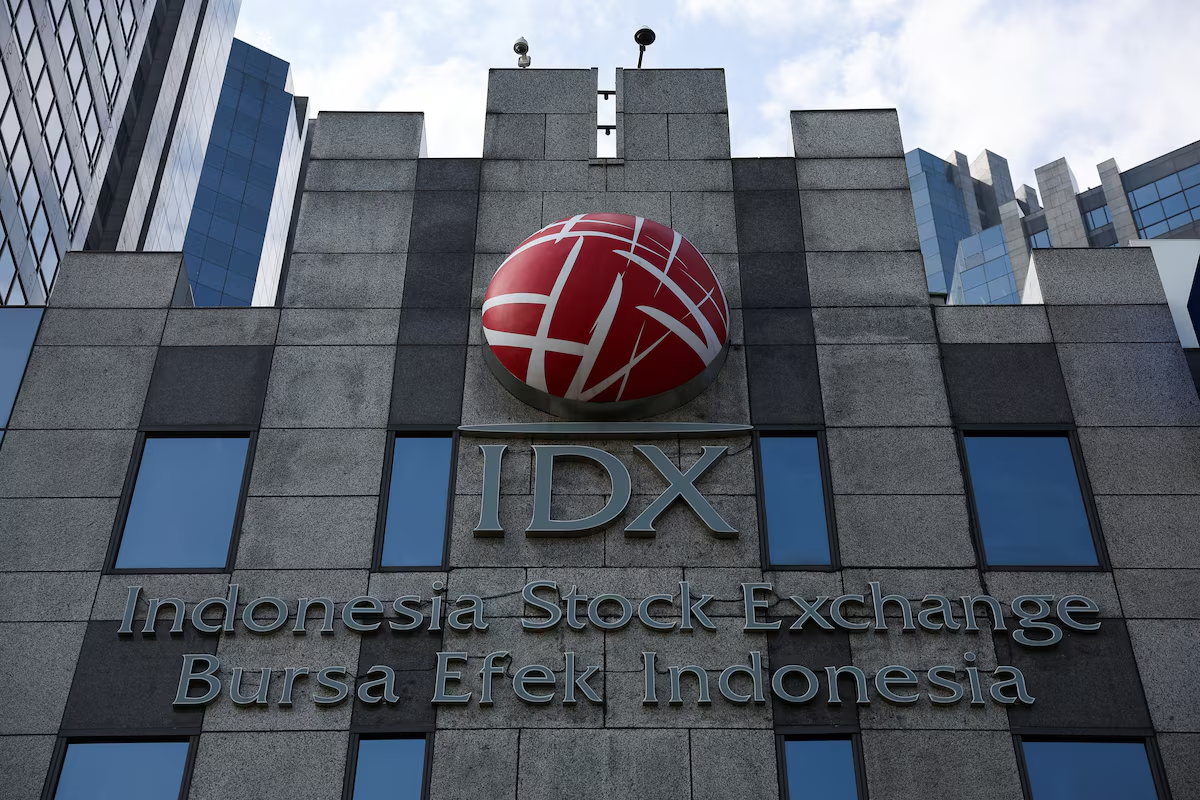
Indonesia’s capital market reforms have gained urgency following heightened volatility in the stock market after Morgan Stanley Capital International (MSCI) froze changes to its Indonesia index. The move triggered sharp sell-offs across sectors and raised concerns among global investors about transparency and market governance.
However, policymakers view the turbulence as short-term and manageable. Instead of signaling economic weakness, officials argue the episode provides momentum to accelerate long-planned reforms aimed at strengthening investor protection and ensuring long-term market stability.
National Economic Council (DEN) Chair Luhut Binsar Pandjaitan urged investors to remain calm as markets adjusted to the MSCI decision. He stressed that recent price movements do not reflect a deterioration in Indonesia’s economic fundamentals. “There is no need to panic,” Luhut said, emphasizing that authorities continue to monitor conditions closely while pushing structural improvements.
Indonesia Capital Market Reforms Target Transparency Gaps
At the core of Indonesia’s capital market reforms lies a renewed push for transparency. The government, working with the Financial Services Authority (OJK) and the Indonesia Stock Exchange, plans to tighten disclosure requirements for major listed companies. These measures include clearer reporting of ultimate beneficial owners, stronger verification mechanisms, and firm sanctions for violations. Policymakers believe transparency remains essential for restoring confidence after MSCI cited governance-related concerns.
According to Luhut, transparent ownership structures allow investors to better assess risk and discourage unhealthy market practices. “Investor protection and market stability are the top priorities,” he said. By aligning disclosure standards with global norms, regulators aim to rebuild trust and create a fairer investment environment for both domestic and foreign participants.
MSCI Index Freeze Raises Concerns Over Market Governance
The MSCI index freeze became the immediate catalyst for market anxiety. MSCI pointed to transparency issues and alleged coordinated trading behavior as reasons for halting index adjustments. Because many global funds track MSCI benchmarks, the decision sparked broad portfolio sell-offs and amplified volatility across Indonesia’s equity market.
Still, authorities insist the decision should not be misread as a negative judgment on the broader economy. Luhut described the warning as an opportunity rather than a setback. “The MSCI warning is an honest reflection of areas that need improvement. This is momentum to build a credible capital market that investors trust because the system is strong, not because of speculation,” he said. In this context, reform momentum has taken precedence over short-term market reactions.
Investor Protection Indonesia Becomes Policy Priority
Investor protection in Indonesia has emerged as a central policy focus as regulators respond to heightened volatility. OJK and the stock exchange have stepped up supervision of trading activity, including closer monitoring of unusual transactions and stricter enforcement against market manipulation. Authorities also plan to improve the speed and clarity of market communication to prevent misinformation during periods of stress.
In addition, regulators support the adoption of artificial intelligence tools to detect price anomalies and suspicious trading patterns in real time. Officials expect this technology to strengthen oversight and close gaps that allow unfair practices. As Luhut reiterated, “Investor protection and market stability are the main priorities,” underscoring the government’s commitment to safeguarding market participants.
Indonesia Capital Market Reforms Seek Stronger Domestic Support
Beyond governance, Indonesia’s capital market reforms also aim to strengthen domestic participation to reduce vulnerability to foreign capital swings. The government supports proposals to raise equity investment limits for pension funds and insurance companies, provided prudential standards remain in place. Policymakers believe stronger domestic institutional involvement can provide a liquidity buffer during periods of external uncertainty.
At the same time, authorities plan to accelerate the demutualization of the Indonesian Stock Exchange to improve independence and accountability. Leadership changes at key institutions have further reinforced reform momentum. Luhut emphasized the need for capable leadership, stating, “We need leaders who are brave enough to execute change and enforce the rules. The capital market must become a pillar of Indonesia’s economic growth that is fair and can be enjoyed by the wider public.”
Indonesia Market Stability Depends on Reform Execution
Looking ahead, Indonesia’s market stability will depend less on short-term sentiment and more on consistent reform execution. While the MSCI decision triggered volatility, policymakers view the episode as a turning point to address long-standing governance challenges.
By strengthening transparency, investor protection, and domestic participation, authorities aim to restore confidence and align Indonesia’s capital market with global standards. Ultimately, sustained commitment to these reforms will determine whether the market emerges stronger and more resilient in the long term.
Source: kompas.com, cnbc.indonesia.com
Image: REUTERS/Willy Kurniawan