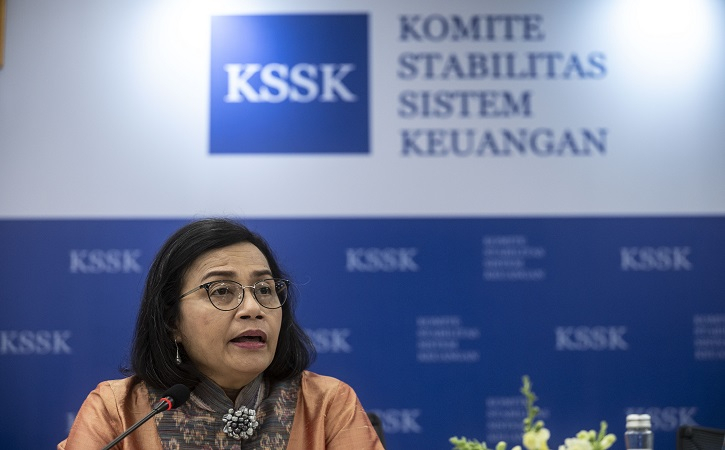
Finance Minister Sri Mulyani Indrawati has issued a warning about growing global investor risk aversion, citing trade tensions and economic uncertainty as major contributors. Speaking at a virtual press conference for the Financial System Stability Committee (KSSK) on April 24, 2025, she emphasized the need for increased vigilance to protect Indonesia’s economy.
Global Investor Risk Aversion Trends Intensify
Sri Mulyani noted that global capital is shifting away from the United States toward safer options. “Global capital flows have shifted from the United States to countries and assets considered safe havens, especially financial assets in Europe and Japan, as well as to gold commodities,” She said as cited by Liputan6.com.
This behavior highlights investor reluctance to engage with risky markets amid rising uncertainty. “Such policies and uncertainties have spurred risk-avoidant behavior among business players and capital owners, leading to a decline in U.S. Treasury yields and weakening the U.S. dollar index,” she added. These movements suggest a widespread preference for lower-risk assets in stable economies.
Emerging Markets Face Capital Outflow Pressure
Sri Mulyani also warned of increasing capital outflows from emerging markets. As investors seek safety, they are withdrawing funds from developing economies, including Indonesia. This trend places pressure on local currencies and may destabilize financial markets.
“Meanwhile, continued capital outflows from emerging markets are exerting pressure on the currencies of various emerging economies,” she stated. The weakening of local currencies may impact trade balances and domestic inflation.
KSSK Acts Amid Economic Uncertainty
In response to these developments, the KSSK—comprising the Finance Minister, Bank Indonesia Governor, OJK Chairman, and LPS Chairman held a coordination meeting. The committee agreed to strengthen economic policy and coordination among financial authorities.
“The meeting agreed to continuously heighten vigilance and strengthen coordination and policies among KSSK member institutions in an effort to mitigate potential spillover risks from global factors while also enhancing efforts to fortify the domestic economy and financial sector,” Sri Mulyani explained.
She reaffirmed that Indonesia’s financial system remained stable in the first quarter of 2025. However, the committee remains cautious due to the unpredictable nature of the global economy.
Trade War Fuels Shift to Safe Haven Assets
The United States’ recent imposition of import tariffs has sparked fears of a broader trade war, increasing volatility across global financial markets. Sri Mulyani noted that these policies could negatively affect not only the U.S. and Chinese economies but also the global economy.
“These policies have triggered tariff wars and are expected to negatively impact economic growth, both for the U.S. economy itself, China’s economy—which is facing off against the U.S.—and the global economy as a whole,” she said.
This environment has pushed investors toward gold and stable foreign markets, intensifying the flow of funds away from emerging economies.
Financial Stability Amid Investor Risk Aversion
Despite growing global investor risk aversion, Sri Mulyani reassured the public that Indonesia’s financial fundamentals remain strong. The KSSK continues to monitor risks while preparing appropriate responses to global economic shifts.
She acknowledged that these developments unfold amid rising expectations of a potential cut in the U.S. Federal Reserve’s benchmark rate. Changes in U.S. monetary policy could influence further capital movements and global investor sentiment.
Sri Mulyani’s warning serves as a reminder of the interconnected nature of the global economy and the importance of strategic policymaking in safeguarding national stability.
Sources: liputan6.com
Images: ANTARA FOTO/Aprillio Akbar