
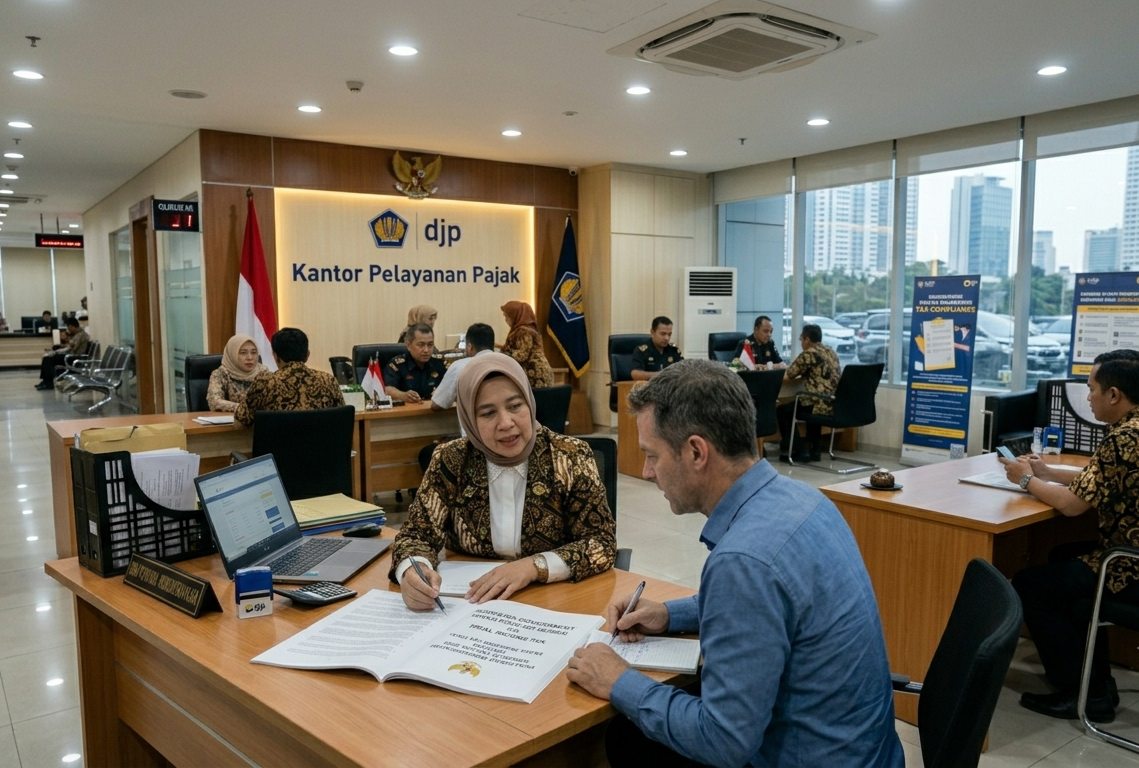
Indonesia has officially tightened the provisions of Final Income Tax for Medium-Small Enterprises/MSMEs through Government Regulation/PP No. 20 of 2026.
This regulation amends the previous framework (PP 55/2022) to tighten the implementation of the popular 0.5% Final Income Tax for small businesses.
This policy shift aims to ensure tax incentives are truly well-targeted while closing loopholes weights previously exploited by larger corporations. For business owners, content creators, and independent professionals, understanding the critical updates in PP 20/2026 is vital to avoiding administrative tax penalties.
The New Indonesia MSME Tax Framework
The new regulation does not change the tax rate itself, which remains at 0.5%. Instead, it significantly narrows down the types of tax subjects eligible to utilize it. Here are the primary changes:
▪ Restricted Eligible Tax Entities: The 0.5% final tax rate can now only be used by Individual Taxpayers, Cooperatives, and Single-Person Limited Liability Companies (PT Perorangan). Conversely, standard Limited Liability Companies (PT), Limited Partnerships (CV), and Partnerships (Firma) have been stripped of this facility. They must now transition to the standard corporate income tax scheme based on net profit.
▪ Elimination of Time Limits for Individuals: In a positive turn for Individual Taxpayers and PT Perorangan, the expiration period for using the 0.5% rate has been removed. You can now benefit from this final tax rate indefinitely, as long as your annual gross turnover remains below the Rp 4.8 billion threshold.
▪ Explicit Exclusion of Influencers and Freelancers: The government has explicitly clarified that independent professionals—such as lawyers, doctors, accountants—and digital creators, including influencers, YouTubers, and content creators, cannot use the 0.5% Final PPh. Income from these activities must be calculated using standard progressive personal income tax rates.
▪ Prohibition on Deducting Bribes and Gratifications: Aligning with global OECD standards, PP 20/2026 strictly notes that expenses for bribes, gratifications, or illegal gifts to public officials cannot be claimed as tax-deductible business expenses.
New System for Calculating Indonesia MSME Tax
One of the most significant structural changes in this regulation is the introduction of an aggregate system (anti-business fragmentation rule) to determine the Rp 4.8 billion threshold.
Previously, many business owners engaged in “firm splitting”—such as dividing one major enterprise into multiple PT Perorangan or separating a husband and wife’s business bookkeeping—to keep individual turnovers under Rp 4.8 billion just to enjoy the lower 0.5% tax.
How Does the Aggregate System Work?
Under PP 20/2026, the Directorate General of Taxes (DJP) is now required to accumulate and combine the total turnover of all interconnected entities within a single family or sole ownership structure.
Turnover Consolidation Rule: The gross revenue (turnover) of a Husband + Wife + All PT Perorangan companies they own is now calculated as a single aggregate value to test against the Rp 4.8 billion threshold.
Calculation Simulation Under the Aggregate System
To see how this works in a practical scenario, consider the following simulation:
▪ Mrs. Rini’s Fashion Business (PT Perorangan A): Annual turnover of Rp 2.5 Billion.
▪ Mr. Budi’s Culinary Business / Rini’s Husband (PT Perorangan B): Annual turnover of Rp 2.8 Billion.
Tax Analysis:
▪ Under Old Rules: PT A and PT B were calculated independently. Since both were below Rp 4.8 billion, both could pay the 0.5% Final PPh.
▪ Under New Rules (Aggregate System): Their turnovers must be combined:
Total Aggregate Turnover=Rp 2.5 Billion+Rp 2.8 Billion=Rp 5.3 Billion
Because the total aggregate of Rp 5.3 billion exceeds the Rp 4.8 billion limit, both PT Perorangan entities lose the right to use the 0.5% Final Income Tax rate. They must calculate their taxes using standard tax rates based on net profit for the current tax year.
Preparing Your Business for the New Indonesia Tax Rules
PP 20/2026 fundamentally reshapes the corporate financial landscape across the country. By restructuring entity eligibilities and introducing the aggregate system, the government has successfully plugged accounting loopholes.
Impacted business owners—especially those managing standard PTs, foreign-owned corporations (PT PMA), or complex multi-business structures—must audit their fiscal bookkeeping immediately to transition smoothly to standard tax reporting.
Staying ahead of shifting regulatory frameworks is the best way to safeguard your company’s growth and compliance. Whether you are navigating the restructured Indonesia MSME Tax guidelines or shifting your foreign investment enterprise to standard corporate tax structures, you don’t have to do it alone.
Reach out to the Seven Stones Indonesia’s Tax & Accounting team today to learn more about how these new tax rules affect your business.