
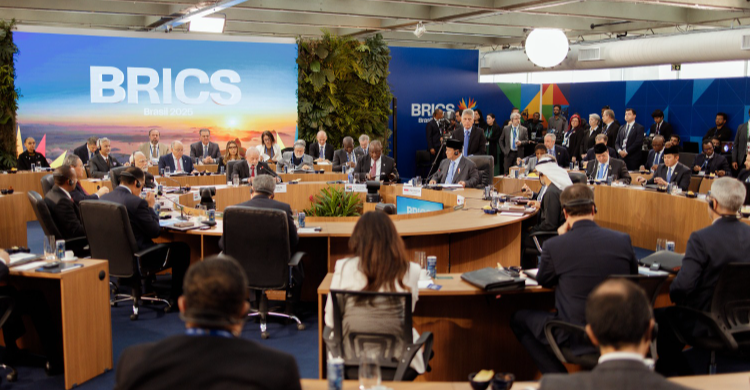
Indonesia remains committed to its BRICS membership despite Trump’s 10% tariff plan targeting member nations. The United States recently threatened to impose a 10% import tariff on countries aligned with what President Donald Trump describes as “anti-American” policies promoted by the BRICS bloc. In response, Indonesian officials reaffirmed their stance and emphasized continued engagement with both BRICS partners and the U.S.
Indonesia Stands by BRICS Despite Pressure
State Secretary Prasetyo Hadi confirmed Indonesia will not withdraw from BRICS despite escalating pressure from Washington. Speaking to reporters at the Parliamentary Complex in Jakarta on July 9, 2025, he stated, “No, we’re not withdrawing from BRICS. What we can say for now is that we’re continuing our efforts to negotiate with the U.S. government.”
Prasetyo emphasized Indonesia’s commitment to ongoing diplomacy. He revealed that negotiations with the U.S. are still underway and that he had coordinated as recently as the night before with Coordinating Minister for Economic Affairs Airlangga Hartarto. Their goal is to navigate the implications of Trump’s tariff policies while protecting national interests.
Read More: President Pushes for BRICS to Become Driver of Global South Economic Cooperation
Details of Trump’s 10% Tariff Threat
President Trump’s 10% tariff threat comes amid broader trade tensions involving BRICS nations. He issued a statement on Truth Social that read, “Any country siding with BRICS’ anti-American policies will be subject to a 10% tariff. There will be no exceptions to this policy.”
Earlier, Trump had warned of tariffs up to 100% should BRICS members abandon the U.S. dollar in bilateral trade. Although his latest remarks did not specify which actions would be considered anti-American, the warning has unsettled global markets and intensified pressure on BRICS participants.
BRICS Response and Economic Implications
BRICS leaders have voiced strong opposition to Trump’s unilateral tariff threat. During the 2025 BRICS Summit in Brazil, member countries, including Indonesia, issued a draft statement condemning the rising use of unilateral sanctions and non-tariff barriers.
The statement expressed “serious concern” over policies that distort global trade and violate World Trade Organization (WTO) rules. BRICS heads of state also agreed to denounce “the imposition of unilateral coercive measures that violate international law,” particularly those involving economic sanctions.
In response to these challenges, BRICS members renewed their commitment to developing cross-border payment systems and other financial mechanisms. Although the initiative has progressed slowly over the past decade, recent developments have spurred greater urgency.
Indonesia’s Diplomatic and Trade Strategy
While maintaining its BRICS membership, Indonesia is actively pursuing strategic dialogue with Washington. According to Prasetyo, Trump has given a deadline of August 1, 2025, before the 32% reciprocal tariff takes effect. In the interim, Indonesian officials are ramping up diplomacy to mitigate the impact.
“It’s not a deadlock. Negotiations are all about offering and counter-offering. The Indonesian government has made its offer. If the U.S. feels it hasn’t met expectations, we’ll try again,” Prasetyo said.
He also stressed that Indonesia believes its proposal addresses most of Washington’s key concerns. “We think the offer we gave the U.S. has already answered what they’ve flagged all this time,” he added.
Read More: Trump Maintains US Import Tariffs on Indonesia at 32%
Navigating a Shifting Global Trade Landscape
Indonesia’s stance highlights a careful balancing act in today’s volatile trade environment. The country remains firm in its BRICS commitment while engaging in active negotiations to avoid fallout from Trump’s 10% tariff plan. As global trade tensions escalate, Indonesia continues to prioritize both sovereignty and economic diplomacy to protect its long-term national interests.
Source: ekonomi.bisnis.com, kabar24.bisnis.com
Image: rm.id