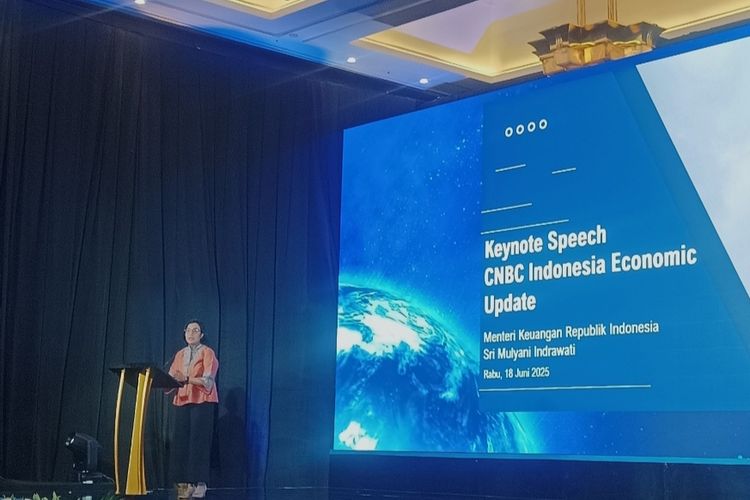
Global economic uncertainty continues to intensify as multilateral institutions lose influence on the world stage. Finance Minister Sri Mulyani Indrawati highlighted this concern during the CNBC Indonesia Economic Update 2025, warning that the World Trade Organization (WTO) is no longer effective in resolving trade disputes or maintaining order in global commerce. “Many countries still hope that if there is a dispute, ‘We have to settle it at the WTO,’ but the WTO now does not, or barely, function,” she said.
WTO’s Diminished Role in Global Trade
Sri Mulyani emphasized that the WTO’s weakened authority has forced many powerful nations to bypass the organization altogether. Once established to provide structure and accountability in international trade, the WTO now struggles to meet the expectations of its member states.
According to Sri Mulyani, “Today, major countries no longer trust multilateral institutions (like the WTO, WHO, etc.) because they feel their interests are not being accommodated. As a result, powerful countries feel, ‘I have to solve my problem without using those multilateral institutions.’” This erosion of trust has made room for growing unilateral actions.
Unilateralism and the Global Economy
Sri Mulyani linked the shift away from multilateralism to rising unilateralism, particularly from the United States. She noted that the U.S., despite being a founding force behind many global institutions, now sees itself as a victim of the very globalization it helped promote. “The biggest country, the United States—economically the strongest—feels victimized by globalization, a system they themselves promoted,” she said.
This mindset has led the U.S. to adopt protectionist policies, such as unilateral tariffs on its trade partners. These moves reflect a broader global trend where countries are increasingly prioritizing national interests over global cooperation.
Global Economic Uncertainty Deepens
Sri Mulyani warned that the world is not facing temporary disruptions but rather a structural shift that could have lasting effects. “We are witnessing that this uncertainty may become more permanent because the nature of this uncertainty is not temporary. It is a shift—one that is likely to have a medium- to long-term impact,” she explained.
As multilateral institutions like the WTO fail to function effectively, the vacuum creates an unpredictable environment. Disputes that were once addressed through structured dialogue now risk escalation through bilateral or unilateral responses, further amplifying global economic uncertainty.
Restoring Trust in Global Institutions
In response to these developments, Sri Mulyani called for reform and renewed trust in global institutions. She underlined the importance of multilateralism as a stabilizing force in global governance. “Many countries still hope for dispute resolution through institutions like the WTO,” she noted, but stressed that its current ineffectiveness only worsens instability.
She argued that without meaningful changes, the global community would continue to fragment. “This competition has reached a point where it’s believed that if one side wins, the other must lose. This situation underlies what we now call uncertainty,” she added.
Navigating a Shifting Global Landscape
As global power dynamics evolve, Sri Mulyani’s remarks offer a sobering view of the road ahead. The weakening of institutions like the WTO and the rise of unilateralism mark a turning point in how nations interact. Unless world leaders recommit to cooperation and institutional reform, global economic uncertainty will likely remain a defining feature of the years to come.
Source: cnbcindonesia.com, cnnindonesia.com
Image: Kompas.com/Dian Erika