
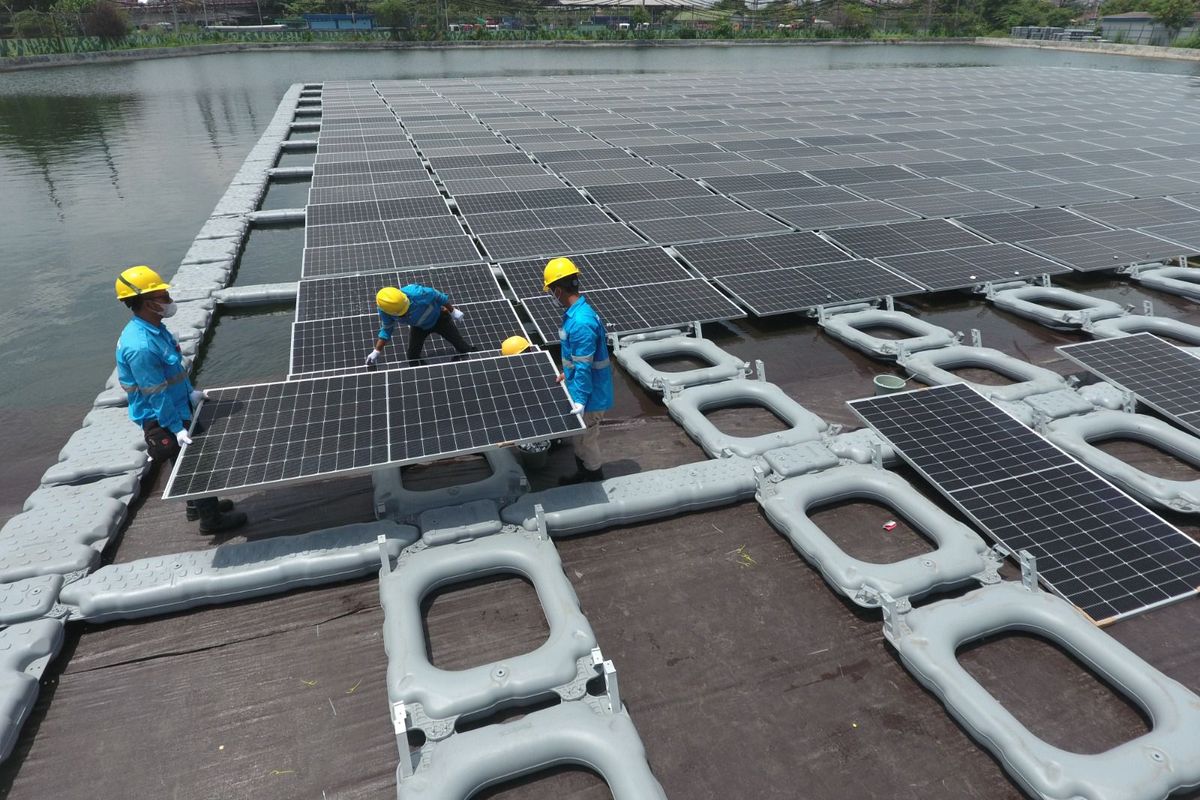
Indonesia’s clean energy transition could significantly enhance the country’s economic performance. According to the Ministry of Finance, referencing World Bank data, Indonesia may achieve annual economic growth of 1% to 1.5% by successfully implementing a clean energy transition. This projection reflects the increasing role of renewable energy in driving investments, industrial diversification, and job creation.
Boby Wahyu Hernawan, Head of the Center for Climate Finance and Multilateral Policy at the Fiscal Policy Agency, emphasized the broader global trend fueling this momentum. “Global investment in clean energy manufacturing is also growing rapidly, driven by supportive industrial policies and rising market demand. This surge in investment not only fosters innovation but also creates jobs,” he said during the Indonesian Private Sector Readiness in Climate Finance event held in Jakarta on April 25, 2025, as reported by Detik.com.
Government Spending and Climate Action Funding
The government has backed its commitment to clean energy with substantial public funding. Between 2016 and 2023, Indonesia allocated a total of IDR 610.12 trillion toward climate change mitigation through its State Budget (APBN). This amount equals an average of IDR 76.3 trillion per year or roughly 3.2% of the total annual budget.
“The Indonesian government has allocated an average of IDR 76.3 trillion per year for climate action, equivalent to 3.2% of the annual State Budget, with a cumulative total of IDR 610.12 trillion since 2016,” Boby stated.
However, current funding levels remain insufficient for long-term goals. More financing is required to support large-scale infrastructure and innovation in the renewable sector.
Massive Funding Needed for Net-Zero Goals
Reaching net-zero carbon emissions by 2060 will require unprecedented investment. According to the Ministry of Energy and Mineral Resources (ESDM), Indonesia needs up to USD 1 trillion—equivalent to IDR 16,816 trillion—to meet its emission targets.
Meanwhile, the Just Energy Transition Partnership (JETP) estimates that Indonesia will need USD 97.1 billion by 2030 and USD 580.3 billion by 2050. The International Energy Agency (IEA) projects that globally, energy transition efforts must attract between USD 4 trillion and USD 5 trillion annually until 2030.
Indonesia’s Renewable Energy Potential
Indonesia holds one of the world’s largest untapped renewable energy resources. Deputy Minister of Investment Todotua Pasaribu highlighted that the country has up to 3,600 gigawatts (GW) in clean energy potential, particularly from geothermal, solar, and hydro power.
“When we talk about renewable energy, we’re looking at enormous potential. If we can consolidate it, we’re talking about up to 3,600 GW of energy that can be developed,” he said during the Indonesia Investment Talk Series on April 30, 2025.
Geothermal Energy Indonesia and Hydrogen Innovation
As part of the Indonesia clean energy transition, geothermal energy stands out. Although the country has a geothermal potential of 24,000 megawatts (MW), only 672 MW has been developed so far. Regions along the Ring of Fire, such as Sumatra, Java, and Sulawesi, offer prime conditions for geothermal projects.
“As I mentioned earlier, being part of the Ring of Fire, regions such as Sumatra, Java, and Sulawesi hold extraordinary geothermal potential. At present, around 672 MW of renewable energy capacity has been installed,” Todotua said.
Indonesia is also exploring hydrogen production using geothermal power. Todotua noted, “There’s a concept called hydrogen development, where we utilize electricity from geothermal sources to develop the hydrogen industry. This hydrogen industry is a green commodity sector with significant value.”
Unlocking Indonesia’s Green Economy Growth
The Indonesia clean energy transition holds promise not only for the environment but also for sustainable economic growth. With vast renewable resources and supportive policies, the country is poised to attract long-term investment and become a regional green energy leader. Achieving this goal, however, will require closing the funding gap and accelerating project development across all clean energy sectors.
Source: finance.detik.com
Image: PT PLN (Persero), via official documentation.