
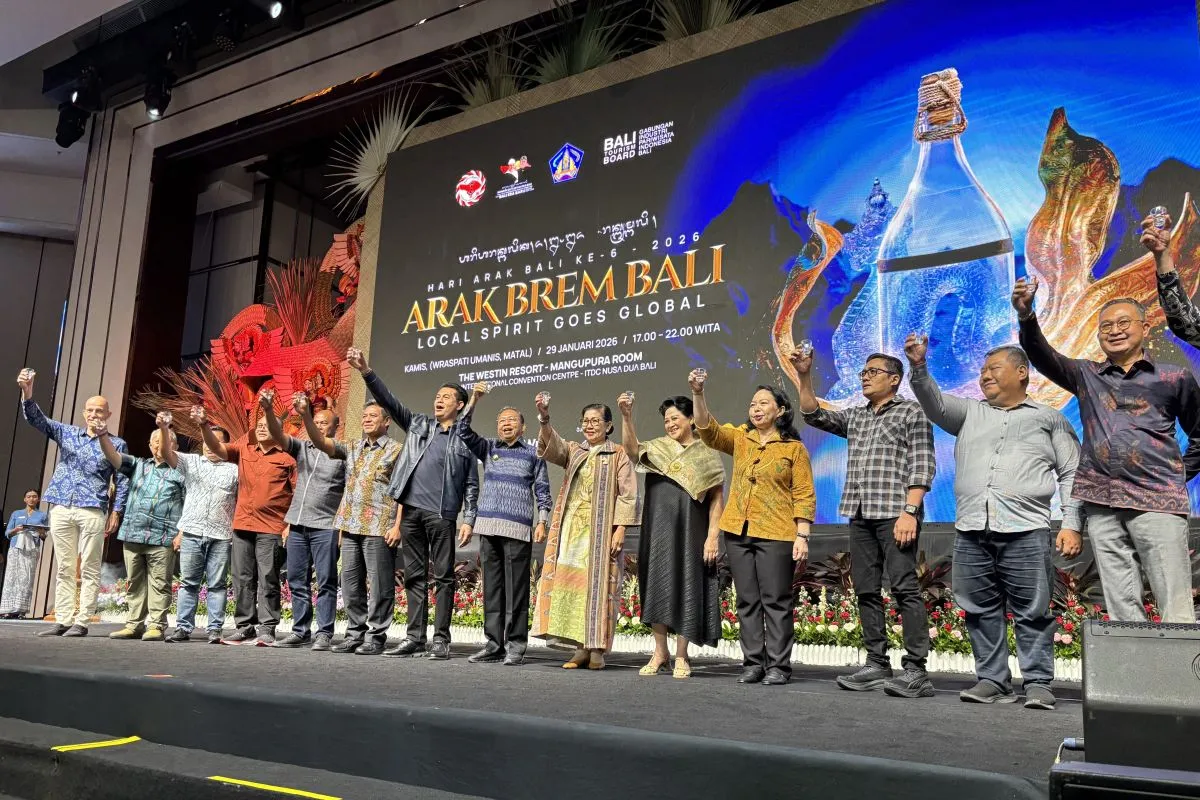
Bali Arak has entered a new phase of development as Indonesia’s Ministry of Industry formally granted an industrial business license to support its production and distribution. This decision marks a major shift for Bali’s traditional fermented and distilled beverages, which now operate under a regulated, export-oriented framework.
For years, local producers struggled with high compliance costs and limited access to legal distribution channels. Now, government-backed licensing opens the door for wider market acceptance, improved quality standards, and stronger global competitiveness. More importantly, the move positions Bali arak not only as a cultural symbol, but also as a sustainable economic asset for local communities.
Bali Arak Receives Official Business License
The Ministry of Industry issued the business license during the 6th Bali Arak Day celebration in Badung. The license allows PT Kanti Barak Sejahtera, a subsidiary of Bali provincial government–owned Perumda Kerta Bali Saguna, to manage the production and distribution of alcoholic beverages in the province. Acting Director General of Agro Industry at the Ministry of Industry, Putu Juli Ardika, confirmed the handover and explained its purpose.
“At this moment, we are handing over an industrial business license that will be used by a subsidiary of Perumda Kerta Bali Saguna, which has been appointed to manage the alcoholic beverage production license for the Province of Bali under the name PT Kanti Barak Sejahtera,” he said.
Through this license, the government aims to simplify regulation and ensure legal certainty for producers. As a result, Bali arak can now develop within a clear industrial framework that supports accountability, safety, and long-term growth.
Arak Bali Industry Strengthens Local Producers
The new licensing system directly supports more than 1,472 arak farmers and artisans across Bali. Previously, many producers relied on third-party licensed companies, which increased operational costs and limited independence. Now, a centralized provincial license offers a more inclusive and affordable structure.
Putu Juli Ardika emphasized that the company managing the license should prioritize producer development. “Going forward, this company can focus on mentoring arak farmers and artisans, including improving quality, standardization, packaging, and marketing, so the product can be accepted by consumers and be export-oriented,” he said.
By focusing on training and quality control, the industry can raise product standards while preserving traditional production methods. This approach ensures that local producers remain competitive without losing cultural authenticity.
Bali Arak Brands Expand Across the Island
Currently, 58 legally registered Bali arak brands operate under 18 cooperatives spread across eastern, northern, southern, and western Bali. This expansion reflects steady industry growth since the issuance of Bali Governor Regulation Number 1 of 2020, which formally recognized arak and brem as cultural products.
Bali Governor Wayan Koster welcomed the new license, stating that it removes one of the last major obstacles for local producers. He urged PT Kanti Barak Sejahtera to unite cooperatives and brands under one legal umbrella. “I ask PT Kanti Barak Sejahtera to manage this license for production and distribution purposes, sheltering all cooperatives and arak producers in Bali so they no longer need to rely on costly third-party companies,” Koster said.
This structure allows producers to scale operations while maintaining consistent standards across the island.
Export Growth Signals Global Market Acceptance
Beyond domestic growth, Bali arak has started to gain international recognition. Export values for Category C alcoholic beverages, including Bali arak, increased throughout 2024 and 2025. Key export destinations include Thailand, China, the Netherlands, and the United Arab Emirates.
According to Putu Juli Ardika, traditional alcoholic beverages should not be viewed solely as commercial alcohol products. “Traditional alcoholic beverages should not be viewed merely as alcohol, but as integral parts of customary rituals and symbols of social togetherness,” he said.
He added that rising export demand shows strong global interest and a supportive industrial climate. “This shows that demand for Indonesian-produced alcoholic beverages continues to grow, and that the industrial climate is supportive of becoming an export-oriented production base,” he said.
Bali Arak Enters a New Industry Era
With formal licensing in place, Bali arak has transitioned from informal production into a regulated and globally competitive industry. The policy supports local farmers, strengthens cooperatives, and improves market access without sacrificing cultural value.
As export demand continues to grow, Bali arak stands poised to become both a symbol of heritage and a driver of economic development. This new chapter signals a sustainable future where tradition and industry advance together.
Source: antaranews.com, beritadewata.com
Image: ANTARA/Ni Putu Putri Muliantari