
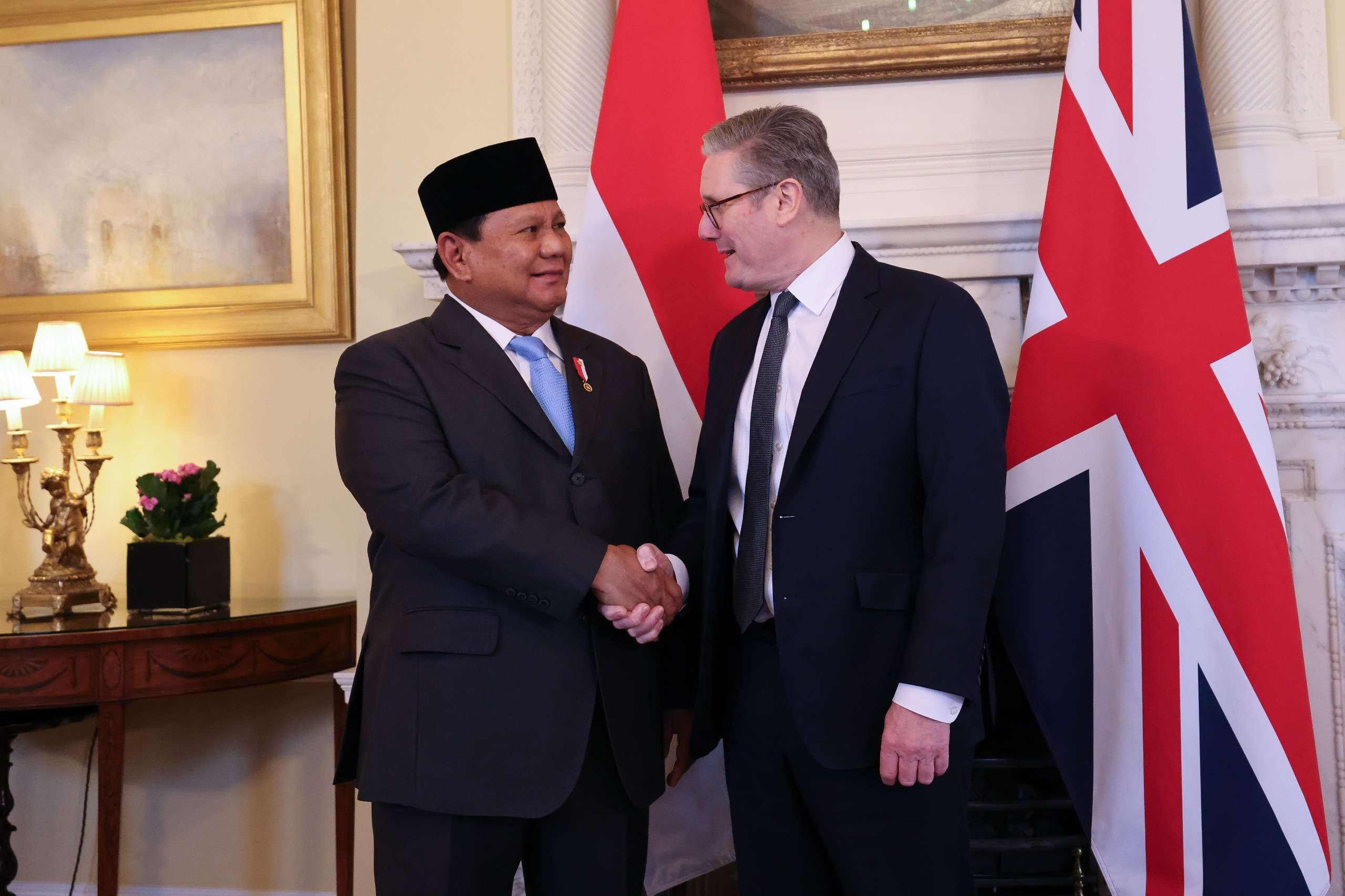
President Prabowo Subianto flew to London to meet with British Prime Minister Keir Starmer to strengthen Indonesia’s partnership with the UK. The partnership encompasses broad cross-sector cooperation to advance strategic alliances across the economic, maritime, education, and energy sectors.
The meeting at 10 Downing Street on January 20 reflected growing momentum in bilateral ties as both leaders signaled stronger collaboration and long-term diplomatic engagement.
Prabowo framed the United Kingdom as a key partner for Indonesia, particularly as Jakarta seeks to boost economic growth, enhance defense capabilities, and accelerate the transition to clean energy.
He underscored the complementarity between Indonesia’s economic potential and the United Kingdom’s technological and financial strengths. “They have technology, they have very strong finances, they are interested in investing in Indonesia, and we believe we can benefit from their technology and financial capacity,” Prabowo said during his visit.
Indonesia–UK Partnership Gains Momentum After London Meeting
The London meeting marked a continuation of earlier diplomatic exchanges that have elevated bilateral relations into a more structured strategic partnership. Starmer acknowledged rapid progress since Prabowo’s initial visit, noting that the agenda had begun translating into tangible cooperation. “This was something we discussed in our previous meeting, so I’m very pleased you could return,” he said.
Both leaders emphasized the strategic value of deepening ties in an increasingly complex geopolitical environment. Indonesia views the partnership as a pathway to long-term economic modernization, while the United Kingdom seeks to expand its presence in the Indo-Pacific. The dialogue also reflected Jakarta’s ambition to diversify foreign partners beyond traditional economic allies.
Economic and Energy Cooperation Dominate Bilateral Agenda
Economic cooperation stood as one of the most visible pillars of the meeting. Both countries discussed expanding collaboration across renewable energy, digital economy, transport infrastructure, agriculture, and financial services.
The United Kingdom expressed a strong interest in Indonesia’s clean energy transition, particularly through tidal energy development. British support targets up to 40 megawatts of tidal power capacity by 2028, aligning with Indonesia’s broader ambition to add 42.6 gigawatts of renewable generation capacity over the coming decade.
Private investment and financial sector participation also featured prominently. Both governments welcomed a stronger role for financial institutions and the private sector in accelerating Indonesia’s energy transition. Discussions further touched on Islamic finance and agricultural trade, reflecting the wide-ranging economic scope of the partnership.
Maritime and Defense Programs Strengthen Security Cooperation
Maritime and defense cooperation formed another major pillar of the bilateral agenda. Starmer highlighted recent progress following the launch of the Maritime Partnership Programme last November. The initiative aims to enhance Indonesia’s naval and fishing fleet capabilities as part of broader maritime security and Indo-Pacific stability efforts.
Prabowo advanced defense cooperation through meetings with the British defense company Babcock. Both sides explored modernization initiatives that would strengthen naval capacity and improve maritime defense infrastructure. These discussions reinforced the security dimension of the relationship and positioned maritime cooperation as a key feature of Indonesia’s Indo-Pacific engagement strategy.
Indonesia–UK Partnership Extends to Education and Human Capital
Education cooperation signaled a significant expansion of bilateral priorities beyond defense and economics. Prabowo held discussions with the Russell Group, an association of 24 leading research universities in the United Kingdom. The talks emphasized academic collaboration, research partnerships, and vocational capacity building that would support Indonesia’s human capital development.
Starmer confirmed education as a major priority for future cooperation and noted Prabowo’s engagement during his earlier visit. “You have a lot to discuss, including education, which you paid great attention to during your last visit, and again I’m very glad we continue to make progress,” he said.
Prabowo’s Diplomatic Push Signals New Strategic Direction
The meeting concluded with a shared commitment to strengthen cooperation across economic, maritime, and educational sectors. Prabowo’s United Kingdom visit reflected Jakarta’s growing diplomatic and geopolitical ambition, as Indonesia positions itself as a consequential actor in regional and global affairs. With plans for further collaboration already underway, both governments signaled a decisive shift toward a long-term strategic partnership that serves mutual interests and supports Indonesia’s modernization goals.
Source: rm.id, fraksigerindra.id
Image: RRI (Radio Republik Indonesia)