
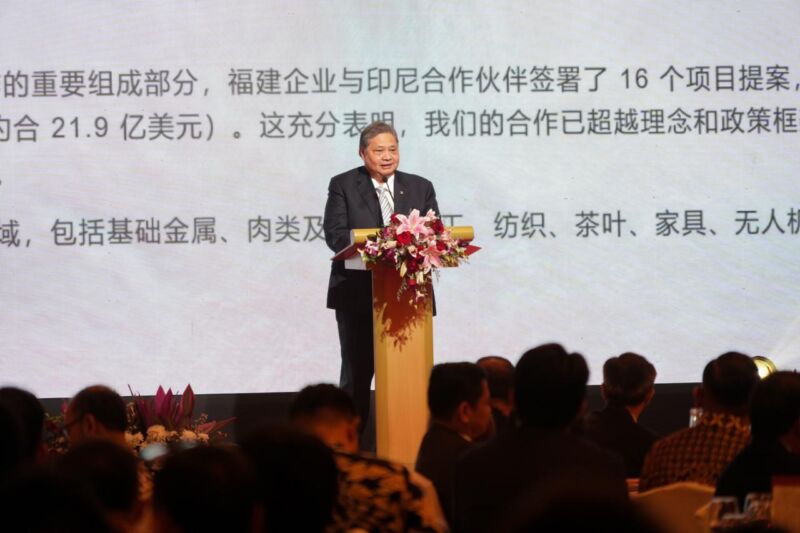
China-Indonesia Investments continue to expand as both countries strengthen economic ties through a series of strategic industrial collaborations. The Indonesian government recently confirmed the signing of 16 industrial project proposals between companies from Fujian and Indonesian partners with a total investment value of around IDR 36–36.7 trillion or roughly US$2.19 billion. The move underscores a deeper economic alignment between two major G20 markets and highlights Indonesia’s efforts to attract long-term foreign investment.
China-Indonesia Investments Expand Through TCTP Framework
The Two Parks Twin Countries (TCTP) initiative has become the main framework supporting greater industrial cooperation between the two nations. Indonesia first launched the initiative in 2021 and updated it in May 2025 through a memorandum signed by Coordinating Minister for Economic Affairs Airlangga Hartarto and China’s Minister of Commerce Wang Wentao. President Prabowo Subianto and Premier Li Qiang witnessed the signing, which signaled strong political commitment at the highest level.
Airlangga highlighted the scale and economic potential behind the collaboration. “With a population of 1.4 billion people, China ranks second in the world, while Indonesia has 285 million people and ranks fourth. Both are members of the G20, and China is the world’s second-largest economy with a GDP of US$17.8 trillion, while Indonesia has a GDP of US$1.4 trillion. So this is truly a significant milestone showing that collaboration between the two countries remains wide open.”
Trade relations also continue to deepen. China remains Indonesia’s largest trading partner with total bilateral trade reaching US$135.2 billion in 2024. Through TCTP, both governments aim to streamline industrial collaboration, integrate supply chains, and simplify investment flows.
16 Industrial Projects Target Strategic Sectors
The newly signed projects target a mix of strategic sectors that align with Indonesia’s downstreaming and industrial upgrading agenda. The sectors include basic metals, meat and seafood processing, textiles, tea, furniture, drones, batteries, and artificial intelligence. These industries support Indonesia’s broader plan to enhance export competitiveness and build higher-value production capabilities.
While the government has not disclosed detailed timelines for each project, officials emphasized the importance of expanding cooperation across manufacturing and technology-based industries. The partnership also reflects shared interest in developing future-oriented industries such as drones, batteries, and AI, which could support regional supply chain resilience.
China-Indonesia Investments Supported by Market Scale and Political Signaling
Airlangga described the cooperation as an opportunity benefiting both companies and countries, noting, “It is a massive market that offers opportunities for both companies and countries.” Beyond market scale, institutional actors have played an important role in shaping bilateral relations. Over two decades, the China Chamber of Commerce in Indonesia (CCCI) has served as a communication bridge between government and businesses while fostering closer ties between both societies.
The two G20 members view strategic cooperation as a means to unlock new investment opportunities. Indonesia sees deeper industrial collaboration as a path to supply chain expansion and technology transfer, while China expands its industrial footprint within Southeast Asia.
Regulatory Reforms Aim to Attract Long-Term Foreign Investment
Indonesia continues to adjust policies and streamline regulations to maintain its appeal as a long-term investment destination. Airlangga stated that Indonesia seeks collaboration in renewable energy, logistics, downstream industries, manufacturing, digital economy, quantum computing, food security, health, and human resource development. Moreover, the government formed a task force to accelerate strategic programs and investment processing.
Officials frame these reforms as part of a broader agenda to modernize the investment climate, improve infrastructure, and ensure policy consistency across strategic industries. Together, these measures aim to strengthen investor confidence and position Indonesia competitively in the region.
Outlook for Future Industrial and Technology Cooperation
Looking ahead, the two countries appear committed to advancing cooperation beyond traditional trade. Indonesia welcomes deeper alignment in advanced technology, industrial supply chains, and sectors critical to long-term resilience. The partnership’s momentum suggests that future collaboration may expand into renewable energy, digital services, and emerging technologies.
The signing of 16 industrial projects demonstrates tangible progress and reinforces a positive investment outlook. As Indonesia continues to reform its investment ecosystem and China maintains interest in Southeast Asia’s industrial potential, both markets stand to benefit from more diversified and future-oriented cooperation.
Source: cnbcindonesia.com, finance.detik.com
Image: Kemenko Perekonomian / Niaga.Asia