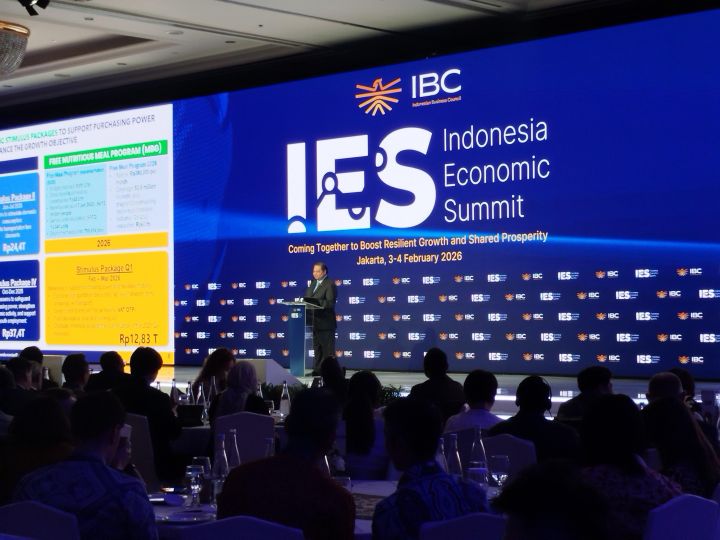
Amid growing global economic uncertainty, the summit is positioned as a strategic platform to reinforce Indonesia’s economic resilience and sustain long-term growth. The Indonesia Economic Summit (IES) 2026, organized by the Indonesian Business Council (IBC), is expected to play a critical role in encouraging investment while strengthening national competitiveness. As global economic conditions remain volatile due to slowing growth and geopolitical tensions, Indonesia seeks to maintain stability through policy clarity, collaboration, and concrete economic action. Scheduled to take place on February 3–4, 2026, the summit brings together key stakeholders to address these challenges and chart a forward-looking economic agenda.
IES 2026 as a Strategic Economic Forum
IES 2026 is designed as more than an annual economic gathering. Instead, it serves as a strategic forum that unites government officials, policymakers, business leaders, and international partners under one platform. Through this structure, the summit aims to strengthen Indonesia’s economic foundations while responding proactively to global uncertainty. The forum emphasizes cross-sector collaboration as a practical solution to complex economic challenges. By aligning public and private sector priorities, the forum seeks to reinforce confidence in Indonesia’s economic direction and institutional capacity.
Moreover, IBC positions the summit as a venue for shaping shared understanding and coordinated action. The discussions focus on building resilience within Indonesia’s economic structure rather than short-term responses. As a result, the summit supports long-term planning that aligns investment flows with national development goals.
IES 2026 Focuses on Investment and Policy Certainty
Investment remains a central pillar of IES 2026, particularly in the context of global economic instability. The summit highlights the need for predictable policies and a competitive investment climate to attract both domestic and foreign capital. Chairman of the IBC Supervisory Board, Arsjad Rasjid, stressed the urgency of this approach during the press conference.
“Amid global uncertainty, Indonesia must be able to provide policy certainty and a competitive investment climate,” he said.
This emphasis reflects Indonesia’s broader strategy to maintain investor confidence despite external pressures. By promoting clear regulations and consistent policy direction, the summit reinforces Indonesia’s position as a stable investment destination. Consequently, the summit aligns investment discussions with competitiveness and long-term economic resilience rather than short-term capital inflows.
Expanding Dialogue to Unlock Market Access
Unlike previous editions, IES 2026 introduces expanded bilateral and multilateral dialogue formats. These sessions aim to open new market access while creating tangible investment opportunities. Through structured discussions with international partners, the summit encourages deeper economic engagement and cooperation. This approach allows Indonesia to strengthen trade relationships and diversify investment sources.
Furthermore, the expanded dialogue format reflects a shift toward outcome-driven engagement. Rather than focusing solely on high-level discussions, the forum prioritizes actionable pathways that support market expansion. As a result, the summit enhances Indonesia’s ability to navigate global economic shifts while securing strategic economic partnerships.
Productivity, Industrialization, and Human Capital
Beyond investment, IES 2026 places strong emphasis on productivity, industrialization, and human capital development. These factors serve as key drivers of long-term economic competitiveness. The summit recognizes that sustainable growth depends on strengthening domestic industries and improving workforce capabilities.
By addressing productivity and industrial development together, the summit supports structural economic transformation. Human capital development, in particular, remains essential to sustaining competitiveness in an increasingly complex global economy. Therefore, the forum links workforce development with industrial growth to ensure that economic progress remains inclusive and resilient.
Turning Dialogue into Concrete Economic Action
The summit ultimately aims to translate dialogue into measurable outcomes. IBC emphasizes that the summit must deliver more than policy discussions. Arsjad Rasjid reinforced this expectation by stating, “What we need now is not just discourse, but real action to drive Indonesia’s economic growth.”
Through an action-oriented approach, IES 2026 seeks to generate concrete policy recommendations and strategic partnerships. These outcomes are expected to strengthen Indonesia’s economic resilience while positioning the country more competitively within the global economy. As global uncertainty persists, the summit stands as a platform for coordinated action, long-term planning, and sustainable economic progress.
Source: metrotvnews.com
Image: metrotvnews.com