
Indonesia Secures 6.7 Billion USD in Mineral Investments

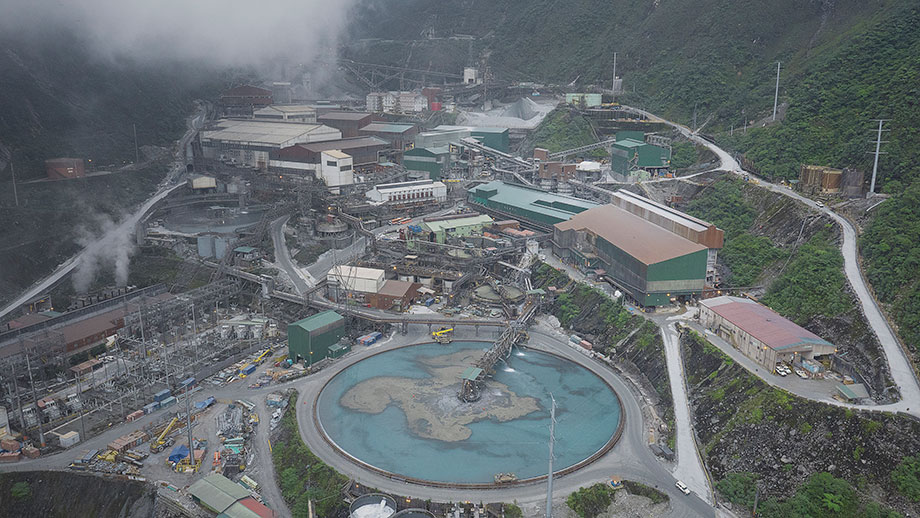
Aerial view of PT Freeport Indonesia’s ore mill surrounded by processing facilities, roads, and mountains, illustrating Indonesia’s mineral investments and downstream mining operations.

Indonesia reached USD 6.7 billion in mineral investments in 2025, reflecting the aggressive push to upgrade its mineral sector through downstream development and value-added production. The government prioritized the completion of several national strategic projects to accelerate the transition from exporting raw materials to producing refined products for high-growth industries, including electric vehicle batteries and energy transition technologies. The Ministry of Energy and Mineral Resources reported that strong mineral investment helped reinforce economic growth and industrial transformation.


Indonesia Mineral Investment Surges on Downstream Strategy

Indonesia accelerated its downstream strategy by pushing major mineral projects across nickel, alumina, and tin. The state mining holding MIND ID advanced several large nickel developments through PT Vale Indonesia’s Indonesia Growth Project portfolio in Sorowako Limonite, Morowali, and Pomalaa.

Collectively, these projects carried an estimated investment value of 8.7 billion USD. The government considers downstream nickel capacity essential for positioning Indonesia within emerging supply chains for electric vehicles and renewable technology. Industry experts argued that this shift away from raw mineral exports reflects a broader commitment to value-added production.

According to the Indonesia Mining Institute Chairman Irwandi Arif, “Downstreaming allows Indonesia to move away from exporting raw materials toward high-value-added products, while strengthening Indonesia’s role in supporting global energy transition.” He noted that Indonesia must also improve exploration to sustain long-term mineral reserves and competitiveness.


Indonesia Mineral Investment Supports Nickel and Battery Supply Chains

Nickel has become central to Indonesia’s attempts to embed itself within EV battery supply chains. The completion of new nickel smelters and refineries enables domestic producers to deliver key intermediate products for battery manufacturing rather than relying on export-driven trade. Consequently, Indonesia deepens its participation in the global shift toward cleaner technologies.

PT Freeport Indonesia also expanded downstream capacity by developing a precious metal refinery in Gresik, East Java, with an investment value of about 630 million USD. The facility will refine anode slime into higher-value products, including gold and silver. This development aligns with efforts to move Indonesia closer to full-cycle industrial production in the mining sector.


Private Sector Participation Expands Critical Minerals Capacity

Private sector participation increased as tin-based downstream plants entered operation in Batam. PT Solder Tin Andalan Indonesia invested roughly 400 billion Rupiah to establish a tin processing facility capable of producing industrial intermediates. PT Batam Timah Sinergi followed with a one trillion Rupiah investment in a downstream tin plant that produces stannic chloride, dimethyl tin dichloride, and methyl tin mercaptide for manufacturing applications.

Industry analysts observed that private sector participation balances state-led initiatives and broadens Indonesia’s mineral base beyond nickel. Growth in tin, alumina, and precious metals enables Indonesia to diversify its mineral resources while attracting foreign capital into supply chains that serve both domestic and export markets.


Energy Transition Minerals Strengthen Indonesia’s Competitive Position

Experts argued that critical minerals increasingly support Indonesia’s ability to compete in the global energy transition. As Irwandi noted, Indonesia faces “a fundamental challenge to increase exploration activity to maintain reserve sustainability and long-term competitiveness.” The call for more exploration coincides with rising demand for critical minerals related to decarbonization and electrification.

However, some analysts voiced caution over potential production restrictions. Indonesia Mining and Energy Watch Executive Director Ferdy Hasiman said, “We expect mineral investments to grow further to support the government’s economic targets. However, production limits could affect the sector’s performance.” He added that restrictions may also drive commodity prices higher and encourage private sector participation as the main engine of investment.


Downstreaming Expected to Drive Future Investments

Indonesia enters the coming years with a clearer industrial direction. Downstreaming strengthens mineral value chains, attracts investment, and integrates Indonesia into strategic industries such as EV batteries and renewable technology. Although challenges persist, including reserve sustainability, price volatility, and regulatory limits, market fundamentals remain favorable.

The government expects further investment inflows as ongoing national strategic projects transition from construction to operation. Private sector activity is also likely to increase as critical minerals gain prominence in global manufacturing. Together, these dynamics reinforce Indonesia’s evolution from a raw material exporter to a producer of high-value-added mineral products that support the world’s shift toward cleaner energy systems.


Source: jpnn.com, rm.id 

Image: PT Freeport Indonesia (ptfi.co.id)

Latest Article
5 Corporate ‘Environmental Sins’ That End in Permit Loss
Corporate environmental violations are at the center of Indonesia’s latest enforcement wave. The government...
Indonesia Investment Outlook Strengthens at WEF Davos 2026
Indonesia’s investment outlook continues to strengthen as the Indonesia Pavilion drew strong global investor...
Indonesia Secures 6.7 Billion USD in Mineral Investments
Indonesia reached USD 6.7 billion in mineral investments in 2025, reflecting the aggressive push to upgrade...
New Semarang Flights Fuel Central Java Foreign Investment
Semarang international flights now accelerate investor mobility as Central Java courts more foreign capital....
Prabowo meets British PM to Strengthen Indonesia–UK Partnership
President Prabowo Subianto flew to London to meet with British Prime Minister Keir Starmer to strengthen...

Andrzej Barski

Director of Seven Stones Indonesia

Andrzej is Co-owner/ Founder and Director of Seven Stones Indonesia. He was born in the UK to Polish parents and has been living in Indonesia for more than 33-years. He is a skilled writer, trainer and marketer with a deep understanding of Indonesia and its many cultures after spending many years travelling across the archipelago from North Sumatra to Irian Jaya.

His experience covers Marketing, Branding, Advertising, Publishing, Real Estate and Training for 5-Star Hotels and Resorts in Bali and Jakarta, which has given him a passion for the customer experience. He’s a published author and a regular contributor to local and regional publications. His interests include conservation, eco-conscious initiatives, spirituality and motorcycles. Andrzej speaks English and Indonesian.

Terje H. Nilsen

Director of Seven Stones Indonesia

Terje is from Norway and has been living in Indonesia for over 20-years. He first came to Indonesia as a child and after earning his degree in Business Administration from the University of Agder in Norway, he moved to Indonesia in 1993, where he has worked in leading positions in education and the fitness/ wellness industries all over Indonesia including Jakarta, Banjarmasin, Medan and Bali.

He was Co-owner and CEO of the Paradise Property Group for 10-years and led the company to great success. He is now Co-owner/ Founder and Director of Seven Stones Indonesia offering market entry services for foreign investors, legal advice, sourcing of investments and in particular real estate investments. He has a soft spot for eco-friendly and socially sustainable projects and investments, while his personal business strengths are in property law, tourism trends, macroeconomics, Indonesian government and regulations. His personal interests are in sport, adventure, history and spiritual experiences.

Terje’s leadership, drive and knowledge are recognised across many industries and his unrivalled network of high level contacts in government and business spans the globe. He believes you do good and do well but always in that order. Terje speaks English, Indonesian and Norwegian.

Contact Our Consultants

Ridwan Jasin Zachrie

CFO of Seven Stones Indonesia, Jakarta

Ridwan is one of Indonesia’s top executives with a long and illustrious career in the financial world. He holds several professional certifications including being a Certified Business Valuer (CBV) issued by the Australian Academy of Finance and Management; Broker-Dealer Representative (WPPE); and The Directorship Certification for Directors and Commissioners, issued by the Indonesian Institute of Commissioners and Directors.

His experience includes being the Managing Director at one of the top investment banking groups in the region, the Recapital Group, the CFO at State-owned enterprises in fishery industry and the CEO at Tanri Abeng & Son Holding. He’s also been an Independent Commissioner in several Financial Service companies and on the Audit and Risk Committee at Bank BTPN Tbk, Berau Coal Energy Tbk, Aetra Air Jakarta as well as working for Citibank, Bank Mandiri and HSBC. His last position was as CFO at PT Citra Putra Mandiri – OSO Group.

Ridwan has won a number of prestigious awards including the Best CFO Awards 2019 (Institute of Certified Management Accountant Australia-Indonesia); Asia Pacific Young Business Leader awarded by Asia 21 Network New York USA (Tokyo 2008); UK Alumni Business Awards 2008 awarded by the British Council; and The Most Inspiring Human Resources Practitioners’ version of Human Capital Magazine 2010.

He’s a member of the Board of Trustees of the Alumni Association of the Faculty of Law, Trisakti University, Co-Founder of the Paramadina Public Policy Institute and actively writes books, publications and articles in the mass media. He co-authored “Korupsi Mengorupsi Indonesia” in 2009, which helps those with an interest in understanding governance in Indonesia and the critical issue of corruption. Ridwan speaks Indonesian and English.

Per Fredrik Ecker

Managing Director of Seven Stones Indonesia, Jakarta

Per is the Managing Director of the Seven Stones Indonesia (SSI) Jakarta office and has more than 25-years’ experience in Indonesia, China, and Western Europe. He previously worked in senior management positions with Q-Free ASA, Siemens AG, and other companies in the telecom sector. Over the last six years, he has been the Chairman of the Indonesia-Norway Business Council (INBC) and recently become elected to be on the board of EuroCham Indonesia.

His most recent experience is within Intelligent Transport Solutions (ITS), Telecom, and other sectors within the Indonesian market. He is today through his position in SSI and by representing Norway Connect, promoting Nordic and European companies that would like to explore business opportunities in the Indonesian market. He’s also playing an active role to help create the Nordic House concept in Jakarta that will provide an excellent platform for Nordic companies entering Indonesia, where they’ll find a community that can offer support with trusted information and affordable services to enter this market.