
Indonesia Oil Imports Unaffected by US Venezuela Tensions

Rising US Venezuela tensions have drawn global attention as markets assess potential disruptions to energy supply and pricing. However, Indonesian authorities say the situation has not affected the country’s oil imports so far. While geopolitical developments in Venezuela raise concerns about global energy stability, Indonesia continues to monitor oil prices closely and prepare precautionary measures.

At the same time, business groups warn that prolonged instability could increase energy costs and pressure production expenses. Together, these views reflect a cautious but controlled outlook on how global geopolitical energy risks may affect Indonesia.


Indonesia Oil Imports Remain Stable Amid US Venezuela Tensions

The Indonesian government confirmed that oil import prices remain stable despite escalating US Venezuela tensions. Coordinating Minister for Economic Affairs Airlangga Hartarto said the government continues to track developments closely while ensuring energy security.

According to Airlangga, short-term market movements show no alarming changes that would immediately affect Indonesia’s import costs. He emphasized that current price levels remain manageable and have not triggered market stress. This position provides reassurance for domestic fuel supply planning and supports broader economic stability as global markets digest political developments in Venezuela.


Government Monitors Global Oil Prices for Potential Risks

In addition, the government continues to monitor global oil prices to anticipate possible shifts. Airlangga stressed that Venezuela’s role as an oil-producing country means political developments could influence global pricing. However, he noted that recent data show limited volatility. “We are monitoring oil prices. Over the past one or two days, there have been no changes and no significant volatility,” Airlangga said.

He added that global oil prices remain relatively low at around US$63 per barrel. Therefore, authorities remain alert while preparing response strategies, should conditions change.


Energy Market Volatility Raises Concerns for Manufacturers

Meanwhile, business leaders remain cautious about broader energy market volatility. The Indonesian Chamber of Commerce and Industry (Kadin) has warned that geopolitical tensions could lead to higher energy and logistics costs. Kadin Vice Chairman for Industry Saleh Husin explained that disruptions in global energy markets often result in higher transportation and distribution costs.

“This disruption has the potential to affect transportation and distribution costs, which in turn will impact manufacturing input costs,” Saleh said. As a result, export-oriented industries and energy-intensive manufacturers must carefully manage costs and adjust strategies if volatility persists.


US Venezuela Tensions Have Limited Impact on Global Supply

Despite these concerns, the direct impact of US-Venezuela tensions on global oil supply remains limited. Venezuela’s oil production has declined sharply over the past two decades and now accounts for less than one percent of global supply.

Most of its exports flow to China rather than broader international markets. Furthermore, the global oil market currently faces a supply surplus due to increased production from several countries amid weakening demand. These conditions help cushion short-term shocks, even as political risks continue to influence investor sentiment.


Indonesia Energy Assets Abroad Remain Unaffected

At the corporate level, Indonesia’s state-owned energy interests in Venezuela also remain secure. PT Pertamina Internasional Eksplorasi dan Produksi confirmed that its assets have not suffered any operational impact following the US action. “In relation to the latest developments, based on our monitoring so far, there has been no impact on M&P’s assets or staff in Venezuela,” said PIEP Manager of Relations Dhaneswari Retnowardhani. As a precaution, the company continues to coordinate closely with the Indonesian Embassy in Caracas to ensure staff safety and asset protection.

Overall, Indonesia faces manageable risks from current geopolitical developments. While the US Venezuela tensions warrant close monitoring, stable oil prices, limited supply exposure, and ongoing government oversight help maintain confidence. Moving forward, sustained vigilance will remain essential as global energy dynamics continue to evolve.


Source: ekonomi.bisnis.com, antaranews.com

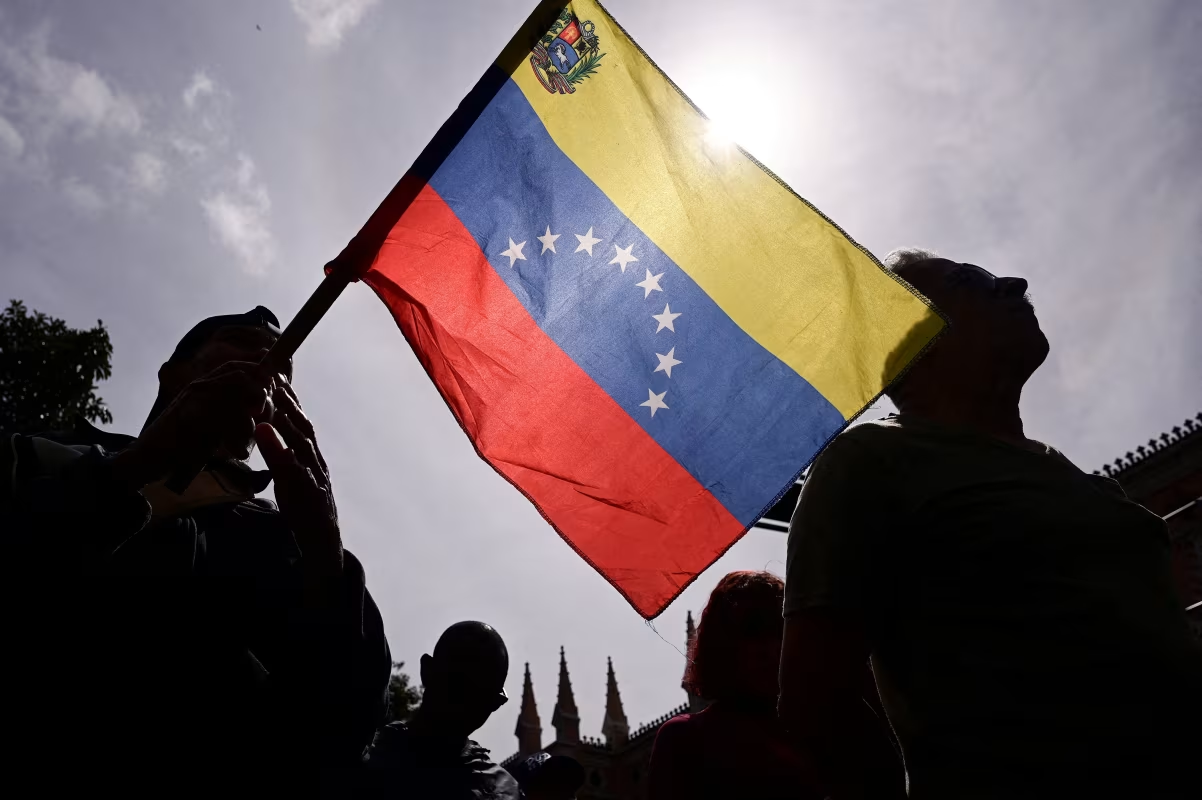
Image: Gaby Oraa / Reuters

Latest Article
Indonesia Economy in 2026 Set to Stay Resilient and Stable
The Indonesian economy in 2026 is expected to remain resilient and stable, supported by steady growth,...
Indonesia Oil Imports Unaffected by US Venezuela Tensions
Rising US Venezuela tensions have drawn global attention as markets assess potential disruptions to energy...
Indonesia Industrial Estates Reach 175 Sites, Investment Up 9.26%
Indonesia’s industrial sector closed 2025 with strong momentum as industrial estates expanded in scale,...
Indonesia Capital Market Outlook Stays Positive Heading into 2026
Indonesia’s capital market remains positive heading into 2026, despite ongoing global uncertainty...
Bali Luxury Hotels Dominate Investment Growth Until 2027
Bali luxury hotels continue to dominate investment growth as the island reshapes its tourism economy...

Andrzej Barski

Director of Seven Stones Indonesia

Andrzej is Co-owner/ Founder and Director of Seven Stones Indonesia. He was born in the UK to Polish parents and has been living in Indonesia for more than 33-years. He is a skilled writer, trainer and marketer with a deep understanding of Indonesia and its many cultures after spending many years travelling across the archipelago from North Sumatra to Irian Jaya.

His experience covers Marketing, Branding, Advertising, Publishing, Real Estate and Training for 5-Star Hotels and Resorts in Bali and Jakarta, which has given him a passion for the customer experience. He’s a published author and a regular contributor to local and regional publications. His interests include conservation, eco-conscious initiatives, spirituality and motorcycles. Andrzej speaks English and Indonesian.

Terje H. Nilsen

Director of Seven Stones Indonesia

Terje is from Norway and has been living in Indonesia for over 20-years. He first came to Indonesia as a child and after earning his degree in Business Administration from the University of Agder in Norway, he moved to Indonesia in 1993, where he has worked in leading positions in education and the fitness/ wellness industries all over Indonesia including Jakarta, Banjarmasin, Medan and Bali.

He was Co-owner and CEO of the Paradise Property Group for 10-years and led the company to great success. He is now Co-owner/ Founder and Director of Seven Stones Indonesia offering market entry services for foreign investors, legal advice, sourcing of investments and in particular real estate investments. He has a soft spot for eco-friendly and socially sustainable projects and investments, while his personal business strengths are in property law, tourism trends, macroeconomics, Indonesian government and regulations. His personal interests are in sport, adventure, history and spiritual experiences.

Terje’s leadership, drive and knowledge are recognised across many industries and his unrivalled network of high level contacts in government and business spans the globe. He believes you do good and do well but always in that order. Terje speaks English, Indonesian and Norwegian.

Contact Our Consultants

Ridwan Jasin Zachrie

CFO of Seven Stones Indonesia, Jakarta

Ridwan is one of Indonesia’s top executives with a long and illustrious career in the financial world. He holds several professional certifications including being a Certified Business Valuer (CBV) issued by the Australian Academy of Finance and Management; Broker-Dealer Representative (WPPE); and The Directorship Certification for Directors and Commissioners, issued by the Indonesian Institute of Commissioners and Directors.

His experience includes being the Managing Director at one of the top investment banking groups in the region, the Recapital Group, the CFO at State-owned enterprises in fishery industry and the CEO at Tanri Abeng & Son Holding. He’s also been an Independent Commissioner in several Financial Service companies and on the Audit and Risk Committee at Bank BTPN Tbk, Berau Coal Energy Tbk, Aetra Air Jakarta as well as working for Citibank, Bank Mandiri and HSBC. His last position was as CFO at PT Citra Putra Mandiri – OSO Group.

Ridwan has won a number of prestigious awards including the Best CFO Awards 2019 (Institute of Certified Management Accountant Australia-Indonesia); Asia Pacific Young Business Leader awarded by Asia 21 Network New York USA (Tokyo 2008); UK Alumni Business Awards 2008 awarded by the British Council; and The Most Inspiring Human Resources Practitioners’ version of Human Capital Magazine 2010.

He’s a member of the Board of Trustees of the Alumni Association of the Faculty of Law, Trisakti University, Co-Founder of the Paramadina Public Policy Institute and actively writes books, publications and articles in the mass media. He co-authored “Korupsi Mengorupsi Indonesia” in 2009, which helps those with an interest in understanding governance in Indonesia and the critical issue of corruption. Ridwan speaks Indonesian and English.

Per Fredrik Ecker

Managing Director of Seven Stones Indonesia, Jakarta

Per is the Managing Director of the Seven Stones Indonesia (SSI) Jakarta office and has more than 25-years’ experience in Indonesia, China, and Western Europe. He previously worked in senior management positions with Q-Free ASA, Siemens AG, and other companies in the telecom sector. Over the last six years, he has been the Chairman of the Indonesia-Norway Business Council (INBC) and recently become elected to be on the board of EuroCham Indonesia.

His most recent experience is within Intelligent Transport Solutions (ITS), Telecom, and other sectors within the Indonesian market. He is today through his position in SSI and by representing Norway Connect, promoting Nordic and European companies that would like to explore business opportunities in the Indonesian market. He’s also playing an active role to help create the Nordic House concept in Jakarta that will provide an excellent platform for Nordic companies entering Indonesia, where they’ll find a community that can offer support with trusted information and affordable services to enter this market.