
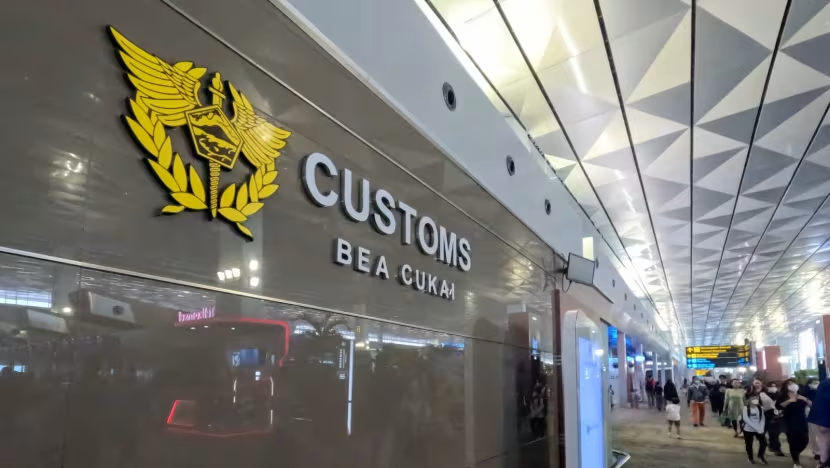
Finance Minister Purbaya Yudhi Sadewa declares a full reform of the Directorate General of Customs and Excise a national priority. During his announcement, he stressed that the customs overhaul must address long‑standing issues of integrity and public confidence. The ultimatum follows a series of revelations about underinvoicing, bribery, and misconduct that have damaged the institution’s reputation and triggered concerns from both the business community and the government.
Purbaya Issues Indonesian Customs Overhaul Deadline
Purbaya explains that the agency’s image has deteriorated in the media, among the public, and even at the highest levels of government. After meeting with Customs leaders, he stresses that the institution must undergo serious reform. According to him, he has already asked President Prabowo Subianto for a one-year window to fix the situation.
He states clearly, “The image of customs is not good in the media, in society, and in the eyes of our highest leadership. So we fix it. We must fix it seriously.” He emphasizes that he requested time to achieve meaningful improvements without disruption, adding, “I told them that I have asked for one year of guaranteed success without interference.”
Rising Scandals Trigger Government Pressure
Mounting scandals intensify pressure on Customs to clean up its operations. Business owners have recently complained about high unofficial fees, including claims from secondhand clothing traders who report that clearing a single container can cost up to Rp 550 million. These allegations highlight the depth of systemic issues inside the institution.
Purbaya also uncovers troubling irregularities during surprise inspections at the Tanjung Perak Customs Office and the Class II Customs Laboratory in Surabaya. There, he finds import documents that list wildly inaccurate values. One example includes a submersible pump recorded at only USD 7, which equals roughly Rp 117,000, despite a real market value of around Rp 40 million to Rp 50 million. The extreme gap signals strong indications of underinvoicing.
He further states, “We studied this carefully. The progress is quite good now. I think next year it will be safe. This means Customs will be able to work well and professionally.” His comments underline the severity of the situation while pointing to initial improvements.
SGS Replacement Threat Puts 16,000 Jobs at Risk
Purbaya stresses the consequences if the overhaul fails. He warns that Customs could face a complete shutdown and replacement by Société Générale de Surveillance (SGS), a Swiss inspection company previously used by Indonesia in the late 1960s under Finance Minister Ali Wardhana. He reiterates this possibility by saying, “If our customs cannot improve their performance and the public remains dissatisfied, customs can be frozen and replaced by SGS, like in the old days. So now customs personnel understand very well the threat they are facing.”
This move would affect 16,000 employees, who may lose their positions if the transition occurs. The scale of the risk has pushed staff to work harder, especially as the agency introduces new systems designed to strengthen transparency and limit misconduct.
Lawmakers Urge Cautious Reform Strategy
Members of the House of Representatives ask the government to weigh the implications of such drastic action. Chairman of Commission XI Mukhamad Misbakhun warns that shutting down an entire directorate requires careful consideration. He states that the Ministry of Finance must analyze potential benefits and drawbacks before making a final decision.
Lawmakers acknowledge public dissatisfaction but also insist that Customs should receive a fair chance to correct internal issues. They agree that the ultimate decision rests with the Finance Minister, given that the institution operates under his authority.
Technology and Transparency Become Core Solutions
In response to rising pressure, Customs deploys AI systems at multiple checkpoints. These tools aim to detect manipulation, prevent underinvoicing, and reduce opportunities for illicit practices. Purbaya notes that early results show promising improvements and expects next year’s performance to stabilize.
Digital tracking, automated risk scoring, and stricter verification standards form the backbone of this modernization effort. These measures signal a shift toward greater transparency and more accountable trade supervision.
Call for Stronger Customs Accountability
Indonesia now stands at a critical point as Customs works to meet its one-year deadline. The overhaul demands cultural change, technological adoption, and consistent oversight. The institution’s future, along with the fate of thousands of employees, depends on its ability to deliver real accountability and rebuild public trust in the months ahead.
Source: cnbcindonesia.com, money.kompas.com
Image: iStock/Egar Anugrah