
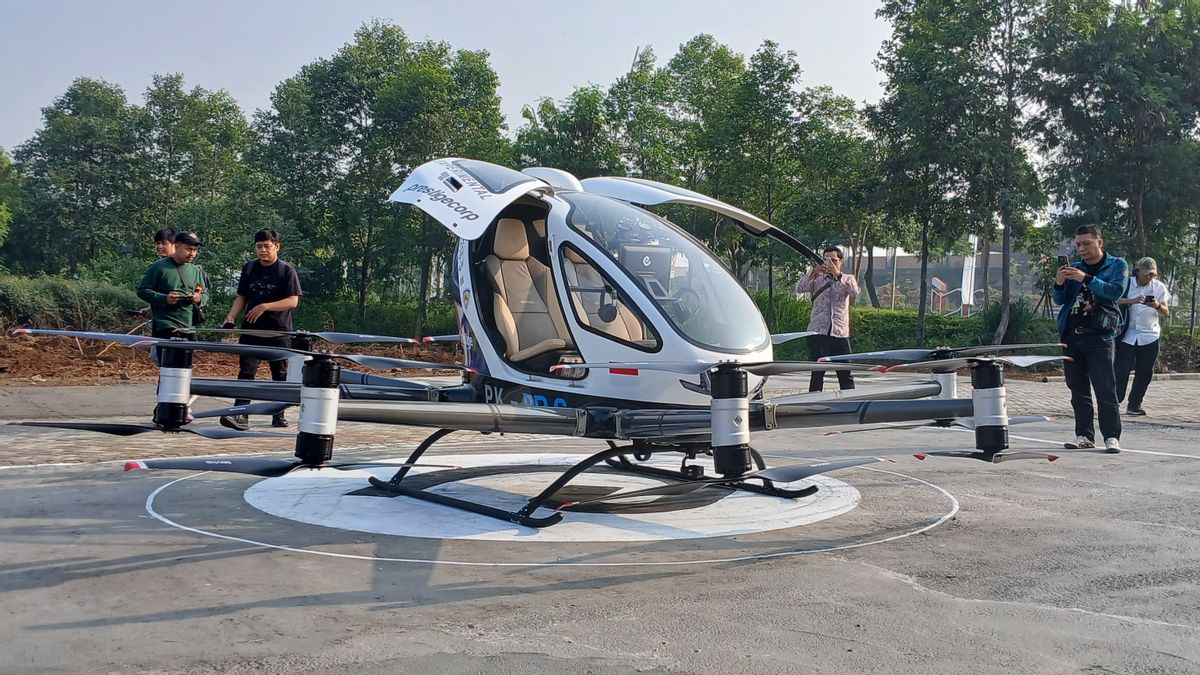
The EHang 216 flying taxi has officially received approval from Indonesia’s Ministry of Transportation to conduct passenger-carrying test flights in Jakarta. This marks a major step forward in the nation’s push toward innovative and sustainable air mobility. On June 25, 2025, the EHang 216-s completed a demo flight with passengers on board at Phantom Ground Park PIK 2 in Tangerang, Banten.
Jakarta Approves EHang 216 Flying Taxi Test Flights
This recent flight test comes after the EHang 216-s secured formal clearance from the Ministry of Transportation. With this approval, Indonesia becomes one of the first countries in Southeast Asia to authorize passenger-carrying drone taxis for trial purposes. Prestige Aviation, the company behind the EHang initiative in Indonesia, successfully conducted the test in Tangerang.
“Our plan is to keep testing the flight so it can become a future mode of transportation or even a tourism option. We’ve brought it to Indonesia so we don’t fall behind other countries,” said Prestige Aviation Executive Chairman Rudy Salim. The June demonstration included actual passengers in the cabin for the first time. Previous trials only featured empty flights or dummies. This milestone strengthens Indonesia’s role in the regional development of electric air mobility.
AI-Powered Drone Taxi for Urban Mobility
The EHang 216-s is an autonomous aerial vehicle (AAV) powered entirely by electricity. Unlike traditional helicopters, it does not require a human pilot. Instead, it uses artificial intelligence to manage flight controls and navigation. The design resembles a giant drone, standing at 1.77 meters high with a width of 5.61 meters.
This flying taxi can carry up to 220 kilograms, fly up to 35 kilometers per trip, and reach speeds of up to 130 kilometers per hour. Its flight duration maxes out at 21 minutes per charge. These features make it ideal for short-range urban transport in dense metropolitan areas like Jakarta.
Future Transport Option for IKN and Tourism
The EHang 216 flying taxi is not only a step toward smarter transportation but also part of a broader vision for Indonesia’s future capital, Nusantara (IKN). Authorities are exploring the integration of this technology into the smart city’s infrastructure. Its compact size and vertical takeoff capabilities suit the city’s design for eco-friendly and efficient movement.
Public figure Raffi Ahmad, appointed as Special Presidential Envoy for Youth and Artists, expressed strong support for the initiative. “Hopefully the EHang 216-s can be operational and help boost tourism, because it’s one way we can stay competitive. Helicopters may be more expensive, but this could be used for things like honeymoons in Bali, offering a unique experience, or as a mode of transport in the new capital, or anywhere else it’s needed,” he said, as cited by Antaranews.com.
Raffi also noted the potential educational value of the project. “For me, this is about raising awareness among the youth, encouraging them to learn and keep learning. Even though EHang is from China and not made here, it’s an opportunity for us to study and adapt good things from abroad,” he added.
EHang 216 Flying Taxi Demo Builds Public Trust
With this recent demo, the EHang 216 flying taxi achieved an important milestone in gaining both regulatory and public trust. “Now we can do demo flights with passengers. This demo helps us gain the government’s trust. Later on, once we receive permits for commercial use, we’ll be able to deliver the units,” Rudy Salim explained as reported by Tvonenews.com.
This achievement also showcases Indonesia’s commitment to supporting emerging technology. The test flight demonstrated operational safety and reliability, encouraging future investment in urban air transport.
Indonesia Eyes Air Mobility Innovation
Indonesia’s successful passenger flight with the EHang 216 flying taxi signals a new chapter in urban transportation. With government support, private sector collaboration, and public interest, the nation is preparing to embrace AI-powered air mobility.
As Indonesia eyes integration into smart cities and tourism, the EHang 216-s may lead the way. Its presence offers not just convenience but also a learning opportunity for local innovators. If future tests continue to succeed, Indonesia could emerge as a leader in Southeast Asia’s flying taxi revolution.
Source: antaranews.com, tvonenews.com
Image: Bagus Muhammad Hafizh/VOI