
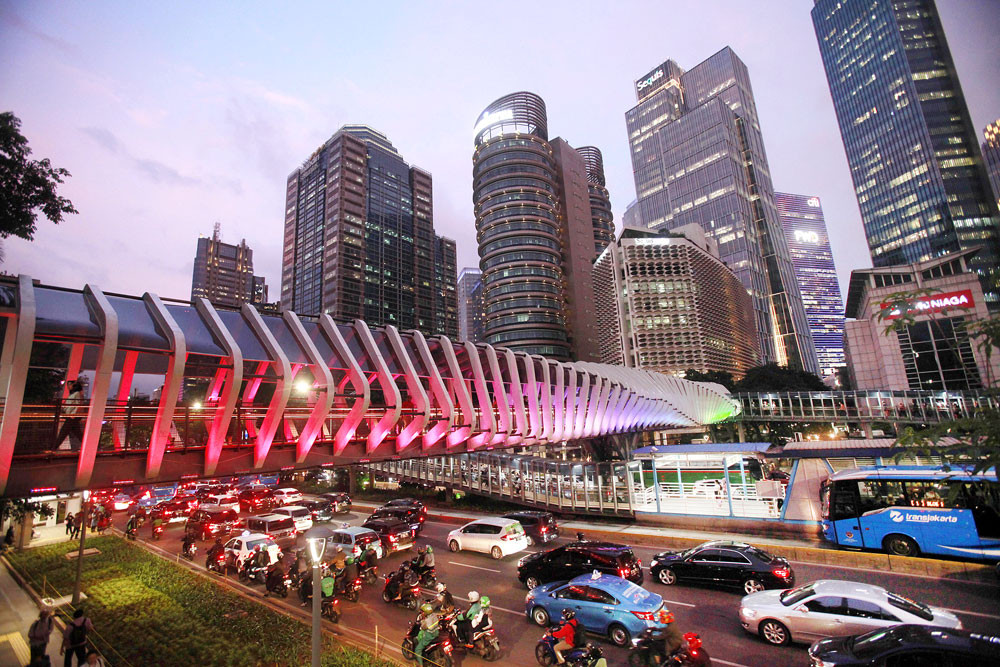
According to Bank Indonesia’s Jakarta Representative Office, Jakarta’s Economic Growth reached 4.95% year-on-year in the first quarter of 2025. This performance surpassed Indonesia’s national growth of 4.87%, signaling the capital city’s economic resilience amid ongoing global uncertainties. Analysts credit this strong start to the year largely to increased household spending, bolstered by seasonal trends and government support.
Household Consumption Drives Jakarta Economic Growth
Household consumption remains the primary engine behind Jakarta’s Economic Growth. It contributed 61.53% to the capital’s economic activity in Q1 2025. This surge came during the Ramadan and Eid al-Fitr period, which traditionally sees heightened consumer spending. In addition, government programs such as food assistance, electricity subsidies, and tax relief further stimulated demand.
“Jakarta’s economic structure still heavily relies on household consumption, which contributes 61.53 percent. This is the main driver of Jakarta’s economic growth amid global challenges,” said Arlyana Abubakar, Head of Bank Indonesia’s Jakarta Representative Office, during the Jakarta Economic Update event on May 8, 2025, as reported by Kompas.com.
Q1 2025 Performance Surpasses National Growth
Jakarta outpaced the national economy in Q1 2025 despite pressures from global trade tensions and a worldwide slowdown. The capital managed to stay on a growth track with a 4.95% increase, compared to the national average of 4.87%.
“Despite global pressures from the U.S.–China trade conflict and the global economic slowdown, Jakarta was still able to record positive performance due to various domestic factors,” Arlyana noted.
Services Sector Remains Economic Backbone
Jakarta’s economy remains dominated by the services sector, which continues to be a key driver of growth. Major contributors include information and communication, trade, financial services, professional services, and food and accommodation.
These sectors reflect Jakarta’s identity as an urban economic center, contrasting with other regions in Indonesia that still depend heavily on agriculture. “This is the economic structure of an urban city. We need policy approaches that align with this characteristic in order to continue boosting Jakarta’s competitiveness as a global city,” Arlyana explained.
Investment Efficiency in Jakarta Still a Concern
However, challenges remain, especially in terms of investment efficiency. The Incremental Capital Output Ratio (ICOR) for Jakarta reached 7.86, significantly higher than the national average of 6.33.
This figure suggests that Jakarta requires more capital to generate the same output as other regions. “A high ICOR is like a car that consumes too much fuel. We’re investing a lot, but the economic output hasn’t been optimal,” Arlyana explained.
The low efficiency is also linked to labor productivity, which has not yet recovered to pre-pandemic levels. This shortfall further hampers Jakarta’s potential for faster economic acceleration.
Urban Challenges and Growth Opportunities
Deputy Governor of Jakarta Rano Karno highlighted additional hurdles, including rapid urbanization and shifting geopolitical dynamics. These external and internal pressures complicate sustainable development in the capital.
“Rapid urbanization, environmental pressures, and global and geopolitical dynamics require an adaptive response,” Rano said at the Bank Indonesia “Connect Jakarta” event.
He emphasized the need for innovation and a collaborative model known as the pentahelix approach, which involves government, academia, businesses, communities, and the media.
“We believe that a collaborative approach through pentahelix synergy plays a significant role in identifying core issues and formulating targeted and sustainable solutions,” he added.
Jakarta Economic Growth to Continue in Q2 2025
Despite these challenges, the outlook for Q2 2025 remains positive. Consumer confidence stays strong, and digital acceleration continues to support economic activities. Jakarta is also preparing to host several major events, which are expected to drive further momentum.
“Jakarta’s growth is no longer just seasonal, it has become a structural trend. Consumption and services will continue to be the mainstays, further supported by digital acceleration and major events in the capital,” said Arlyana. With consistent focus on innovation, inclusive policies, and strategic investments, Jakarta appears set to maintain its upward trajectory in the months ahead.
Source: megapolitan.kompas.com
Image: The Jakarta Post/Iqbal Yuwansyah